
Electric Dirt Bike Fit for Taller and Heavier Riders
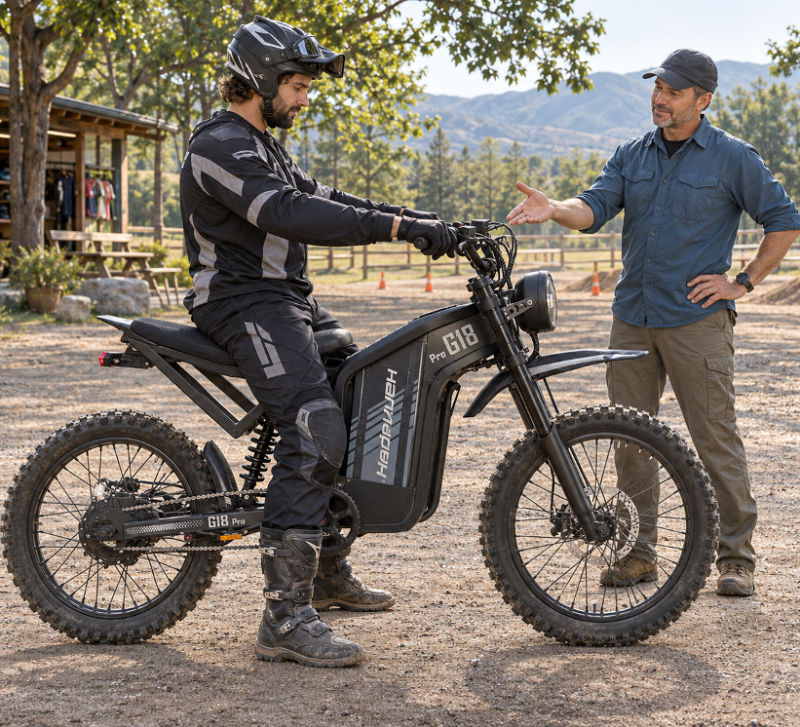
A rider’s height and weight influence bike fit in different ways. Height affects reach and room to move, while carried weight affects suspension setup, braking demands, and the energy needed to climb. Combining both into a single recommendation such as “buy the highest wattage” misses the measurements that make a bike usable.
Start with your riding equipment on and your intended terrain in mind. A tall rider cruising maintained dirt roads faces different demands from a heavier rider practicing tight turns on uneven ground. Neither scenario proves that a specific power threshold or extra-stiff suspension is necessary for everyone.
Calculate the load before comparing performance
Use dressed riding weight, including your helmet, boots, armor, water, tools, and luggage. Check whether the manufacturer’s published limit refers to rider weight, total payload, or gross vehicle weight. Those figures are not interchangeable. Gross vehicle weight includes the bike itself; payload does not. If the definition is unclear, obtain clarification before treating it as a purchasing limit.
Consider a planning example: a 230-pound rider carrying 25 pounds of clothing and equipment creates 255 pounds of payload. That calculation establishes the load to compare with the bike’s specification. It does not establish a margin for jumping, towing, passengers, or other uses the manufacturer has not approved.
When assessing an electric dirt bike for adults, put payload capacity beside seat dimensions, brake specifications, and suspension information. Peak motor wattage can help describe the electrical system, but it cannot correct a cramped riding position or an unsuitable spring. A manufacturer’s overall height range is also less informative than checking your own inseam and reach on the actual bike.
Check the riding triangle while seated and standing
The relationship among the seat, footrests, and handlebar determines where your knees, hips, and arms sit. Seat height alone does not describe that space. A low, wide saddle may require a longer reach to the ground than a slightly taller, narrower one.
With the bike securely supported and powered off, check whether your knees have room when the handlebar turns. Reach the controls with relaxed shoulders and slightly bent elbows. Stand on the footrests in riding boots and see whether you must round your back or lock your knees to reach the bar.
A tall rider may be tempted to fit large bar risers immediately. Confirm the manufacturer’s permitted adjustments first. Cable and hose routing, steering clearance, and control placement must remain correct. Changes that create room in one position can make another position awkward or affect handling.
Ask for a supervised fit check where possible. Being able to sit on a bike in a showroom is useful, but you also need to manage slow turns, stops, mounting, and pushing it when the power is off.
Match the spring and sag to the carried weight
Sag describes how much the suspension settles under load. It helps establish the bike’s working ride height and available movement in both directions. Follow the bike or suspension manufacturer’s procedure and target rather than adopting a generic percentage from another vehicle.
Öhlins’ motorcycle shock setup guidance separates spring preload from compression and rebound damping. On a coil-spring shock, preload changes the spring’s initial compression and affects ride height; damping controls suspension movement. Increasing preload does not necessarily resolve an unsuitable spring rate. Air-sprung units require their own specified setup procedure.
A qualified technician can measure the baseline with you in riding gear and identify whether adjustment is sufficient or a compatible spring is needed. Repeated bottoming, excessive sag, or a harsh response should prompt assessment of the whole setup. Do not mask a persistent problem by maximizing every adjuster.
| Fit concern | Information that helps |
| Knees feel cramped | Seat-to-footrest distance and seated fit |
| Reaching the bar feels awkward | Handlebar reach and approved adjustments |
| Bike settles excessively | Rider sag and compatible spring choices |
| Starts on slopes feel difficult | Control response, gearing, traction, and training |
| Loading is impractical | Actual bike weight and transport capacity |
Evaluate hills with load and gearing in mind
A heavier combined bike-and-rider mass requires more uphill force on the same slope. Whether a machine can provide it comfortably depends on motor output at the operating speed, reduction gearing, current limits, cooling, and tire grip. Peak watts alone do not describe the duration of a climb or the quality of the throttle response.
A controlled demonstration on appropriate terrain can reveal more than an unrestricted acceleration run. Pay attention to whether the machine starts smoothly and whether you can stop and maneuver it confidently. Ask how the manufacturer specifies sustained use and whether temperature protection can reduce output.
Suspension quality, chassis dimensions, and service support are among the factors that drive electric dirt bike pricing. Comparing those items with battery capacity and motor specifications can explain why two similarly rated machines fit very different riders. Spending more on headline power has little value if your remaining budget cannot cover a suitable setup and protective equipment.
Make braking and handling part of the fit decision
Added mass increases the energy the brakes must manage at a given speed. Look beyond the presence of hydraulic actuation: pad and rotor condition, correct installation, lever reach, tire grip, and maintenance all contribute to effective braking. A heavier rider should be able to use the controls comfortably without an awkward grip.
Keep initial practice slow and predictable. Work with an instructor on stopping, balancing, and cornering before moving to more demanding surfaces. A bike that feels manageable on level pavement can be much more difficult to support on loose or uneven ground.
Also assess recovery and transport. If you cannot reposition the bike without straining, plan assistance or choose a machine that better suits the job. Battery weight, rack capacity, and the available loading space deserve attention before a vehicle arrives at your door.
Buy the fit you can verify
Bring a short set of measurements to the buying process: geared-up weight, inseam, comfortable reach, storage dimensions, and transport limits. Ask the seller to connect those measurements to actual specifications, approved adjustments, and available replacement parts.
Choose the bike that accommodates your body and intended riding without relying on major unsupported modifications. A sound starting position, suitable suspension, manageable controls, and dependable service access give you a stronger foundation than an arbitrary minimum power figure.