
Dechecker AI Checker: Why “Well-Written” Text Is No Longer a Safe Assumption
For a long time, writing quality was judged almost entirely by coherence. If a text flowed well, stayed on topic, and avoided obvious mistakes, it passed. That assumption is quietly disappearing as automated evaluation becomes part of academic, editorial, and professional workflows.
Many writers now run finished drafts through an AI Checker not because they doubt their work, but because they know how easily strong writing can be misunderstood by systems trained on patterns rather than intent.
The Shift From Quality to Pattern Recognition
Good writing now leaves statistical traces
Modern AI detectors do not “read” content. They measure regularity, predictability, and probability. Text that consistently chooses the most likely phrasing can appear artificial even when written with care.
This creates a new tension where quality and detectability are no longer aligned.
Fluency became easier to produce
Language models have made fluent writing common. As a result, fluency alone no longer signals effort or authorship. What once distinguished skilled writers is now baseline output.
Detection tools evolved in response, searching for signals beyond surface polish.
Why Human Writing Is Flagged Unexpectedly
Revision removes human hesitation
Editing often removes doubt, rephrasing, and minor inconsistencies. These elements feel messy, so writers cut them. Unfortunately, those same elements are strong indicators of human decision-making.
When revision becomes too aggressive, the final draft may look statistically optimized rather than thoughtfully composed.
Neutral tone increases uniformity
Many writers default to neutral, informative language to avoid risk. Over time, this creates texts with similar cadence and phrasing across unrelated topics.
AI Checker tools frequently surface these passages not because they are wrong, but because they are indistinguishable.
Reading AI Checker Results Productively
Scores point to structure, not guilt
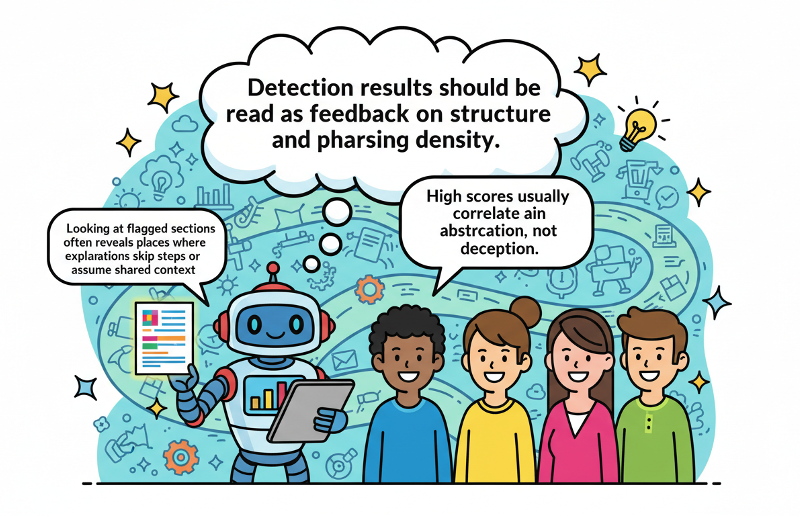
Detection results should be read as feedback on structure and phrasing density. High scores usually correlate with abstraction, not deception.
Looking at flagged sections often reveals places where explanations skip steps or assume shared context.
Local patterns matter more than totals
A single percentage tells very little. Clusters of similar sentences tell much more. When multiple paragraphs share the same rhythm, they often need variation in approach, not simplification.
This reframes revision as clarification rather than evasion.
How Dechecker Fits Into Real Writing Workflows
It identifies compression, not creativity
Dechecker frequently highlights sections where ideas were compressed too tightly. These areas are usually the result of over-editing rather than automation.
Expanding reasoning or adding concrete framing often resolves detection issues organically.
It supports deliberate imperfection
Human writing is rarely perfectly balanced. Sentence length shifts. Emphasis appears unevenly. Dechecker makes it easier to see where that natural unevenness has been edited out.
Restoring it improves both readability and credibility.
Detection in Mixed-Media Content
Spoken content becomes suspicious once cleaned
Speech is naturally redundant and exploratory. When audio is converted into text, much of that texture disappears. The result can look unusually concise.
Content produced through an audio to text converter often triggers detection not because it is artificial, but because editing removed the markers of speech.
Context needs to be reintroduced
Transcripts benefit from light restructuring, but excessive smoothing erases intent. Detection feedback helps editors decide where to preserve original phrasing.
This is especially relevant for lectures, interviews, and research discussions.
Institutional Pressure Shapes Writing Behavior
Fear encourages over-standardization
In environments where AI use is scrutinized, writers often avoid distinctive voices. They choose safe phrasing, predictable transitions, and restrained claims.
Ironically, this defensive writing style increases similarity across texts.
Analytical nuance lowers detection naturally
Texts that examine limitations, compare alternatives, or acknowledge uncertainty tend to register as more human. Detection tools respond well to visible reasoning.
This rewards deeper engagement rather than stylistic tricks.
What AI Checker Tools Cannot Decide
They do not measure understanding
Detection systems cannot assess whether arguments are insightful or correct. They only evaluate linguistic patterns.
High or low scores should never replace editorial judgment.
They cannot infer intent
Using an AI Checker does not imply misuse, and detection results do not prove authorship. They highlight probability, not purpose.
Writers still control how feedback is interpreted and applied.
Writing for Readers and Systems at the Same Time
Presence matters more than polish
Human writing shows where decisions were made. It reflects priorities, not just conclusions. These signals survive even in highly edited work.
AI Checker feedback helps writers protect those signals instead of erasing them.
Dechecker as a calibration tool
Used thoughtfully, Dechecker does not push writers toward awkward phrasing. It encourages balance between clarity and depth.
The result is writing that remains fluent while clearly grounded in human reasoning.
Final Reflection
The challenge today is not avoiding clarity, but avoiding invisibility. Writing that leaves no trace of thought risks being reduced to pattern.
An AI Checker does not punish good writing. It reveals where good writing has become too quiet. Dechecker helps writers bring their reasoning back into the text—without sacrificing precision or trust.