
Why Design-Driven Brands Are Exploring GTM AI Platforms in 2026
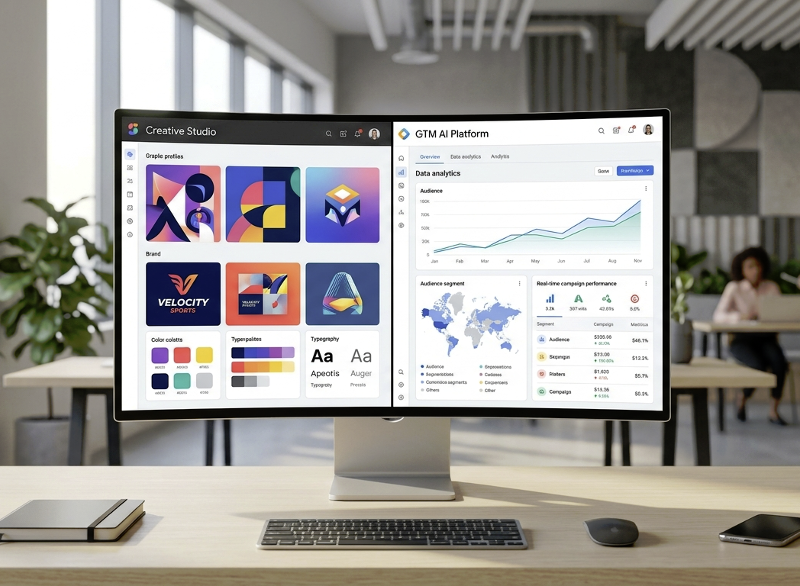
Design-driven brands can grow 32% faster than their competitors, according to McKinsey, and they’ll have spent years winning the market through pixel-perfect aesthetics, obsessive UX, and distinct emotional branding. But in 2026, relying solely on creative intuition is no longer enough to sustain hyper-growth. Beautiful assets fail to convert if they do not reach the exact buyer persona at the precise moment of intent.
The traditional wall between creative teams and growth engineers is collapsing. Design-focused companies are actively adopting artificial intelligence to bridge this gap, ensuring that premium brand experiences are matched with equally sophisticated distribution. By embedding intelligent automation into their go-to-market strategies, these organizations are proving that data-driven distribution need not compromise artistic integrity
Scaling Experience Driven Growth Without Asset Chaos
For an experience-led brand, localized growth campaigns used to mean massive operational friction. Creative directors worried about brand dilution, while marketing teams scrambled to manually alter messaging for dozens of micro-audiences.
This operational bottleneck is why 73% of marketers are using AI to transition their workflows from isolated tools to unified infrastructure. Instead of treating data and design as opposing forces, modern platforms allow growth teams to feed real-time performance metrics directly back to the creators. This creates a continuous loop where audience insights instantly inform the next creative iteration.
To manage this complex intersection of brand identity and rapid deployment, forward-thinking organizations are adopting specialized unified platforms. Transitioning to a dedicated GTM AI infrastructure allows companies to automate communication workflows and synchronize revenue execution without losing their signature visual polish.
Why Legacy Marketing Tech Fails Creative Tech Stacks
Legacy marketing automation suites were built for a different era of internet commerce. They rely heavily on rigid, linear workflows and static data tracking that cannot keep pace with the fluid nature of modern consumer journeys. When a design-centric brand tries to force its dynamic, multi-channel narrative into a legacy pipeline, the user experience invariably suffers.
Modern go-to-market execution demands tools that simultaneously interpret complex user behavior across fragmented channels. Design-driven organizations require platform capabilities that respect the nuances of customer interaction while eliminating technical friction.
Advanced platforms solve this specific problem by introducing a few core operational capabilities:
- Central data engines that link fragmented advertising platforms with customer relationship management systems to provide a single source of truth
- Signal-led insights that identify real-time intent triggers so marketing teams can launch targeted campaigns exactly when a buyer displays high interest
- Automated multi-channel orchestration layers that handle hyper-personalization at scale across diverse digital touchpoints
Implementing these capabilities ensures that a brand’s narrative remains consistent, whether a customer interacts with an avant-garde digital storefront or a programmatic retargeting ad.
Collapsing the Planning Cycle From Quarters to Weeks
In the past, marketing departments planned their initiatives around rigid quarterly calendars. Creative teams spent months perfecting a single concept, only to launch it and realize market dynamics had shifted during production.
The integration of generative tools and advanced analytics has completely collapsed traditional quarterly planning cycles down to weekly iterations. There are thousands of unique audience segments interacting with digital brands every day, and each segment requires a slightly tailored approach to convert effectively. For design-driven businesses, this means your messaging must adjust dynamically based on real-time feedback, rather than relying on a static playbook written three months ago.
This shift to rapid iteration enables growth teams to run highly controlled experiments on audience engagement. Instead of guessing which value proposition resonates with a specific demographic, businesses can utilize predictive models to deploy variations of their core message safely. The creative team retains full control over the overarching design language, while the platform optimizes delivery, timing, and formatting for maximum impact.
Unifying Creative Direction and Revenue Architecture
The ultimate benefit of this technological shift is the total alignment of creative and growth departments. Historically, these two units operated in silos, speaking entirely different languages. Designers focused on brand equity and visual harmony, while growth marketers focused entirely on conversion rates and customer acquisition costs.
By using a shared go-to-market infrastructure, both teams can operate on the same data set. Creators can easily see exactly how their visual choices impact bottom-line revenue, and growth engineers can better understand which brand assets drive long-term customer loyalty. This collaborative environment ensures that every marketing dollar spent supports both the brand’s aesthetic standards and the organization’s commercial goals.
To explore how other digitally native businesses successfully blend performance metrics with premium brand design, keep an eye on our other posts.