
9 AI SEO Tools That Actually Move Rankings in 2026

Most roundups of ai seo tools rank vendors by how loud their marketing is, not by whether anything they ship moves a SERP position or earns a citation inside an AI answer. That’s backwards. I’ve run retainers where the raved-about tool produced a prettier content score and zero movement in ninety days, while a quieter platform clawed forty keywords into the top ten. Scores are not rankings. Buy accordingly.
The answer before the list: for most agency and in-house teams, the strongest all-round pick is SE Ranking. It stacks AI-search visibility tracking (AI Overviews, AI Mode, ChatGPT, Perplexity, Gemini) on real rank, keyword, and audit data, so you act on one dataset instead of reconciling five exports that disagree. The nuance: if your only job this quarter is grinding one draft to the top of one SERP, a content optimizer digs deeper on that axis. Everyone else benefits from the wider view.
42.3% of SEO professionals now use AI writing assistants, and 77% worry AI answers will cut their clicks (SEJ State of SEO 2026). The ranked nine are below.
What an AI SEO Tool Actually Is (And What It Isn’t)
Three separate jobs get crammed under one label, and conflating them is how teams overpay for overlap. Job one is making and optimizing content: briefs, drafts, on-page grading. Job two automates the mechanical work: on-page edits, technical fixes, internal linking at scale. Job three measures whether you actually surface inside AI answers – the domain of ai search optimization tools, and its own discipline now.
Almost every piece of ai seo software does one of these well and fakes the other two. A writing assistant with a thin “AI visibility” widget is still a writing assistant. Sorting tools by the job they genuinely own saves you from stacking three subscriptions that each cover 30% of what you need.
Gartner expects traditional search volume to fall about 25% by 2026 as AI chatbots absorb queries (Gartner). Platforms that ignore where those queries went are selling last decade’s dashboard.
How I Ranked These
- Does it move a real ranking or citation, not just nudge an on-page score no algorithm reads.
- Does it touch AI-answer visibility, not only ten-blue-links SERPs. Half the queries are leaving.
- Data freshness – a tracker refreshing weekly is guessing during the volatile weeks when clients call.
- Fit for multi-client reality: sub-accounts, white-label reporting, per-project separation for twenty domains.
- Honest pricing you can see without a sales call. If the number is hidden, assume it’s high.
I scored these ai based seo tools against live product data and current AI-search behavior in 2026.
| Rank | Tool | Best for | AI capability | Starting price |
| 1 | SE Ranking | All-in-one AI SEO + AI-search visibility for agencies running many clients | AI Results Tracker across 5 AI engines + AI on-page + content editor | $129/mo (core) |
| 2 | Surfer SEO | On-page content optimization at scale | Content grading + AI writer + AI-visibility tracking | $49/mo (annual) |
| 3 | Frase | Fast SERP-driven briefs and drafts | AI briefs + writer + GEO monitoring | $39/mo (annual) |
| 4 | Semrush | Teams already living in the Semrush suite | ContentShake AI + AI Visibility Toolkit | $60/mo (Content Toolkit) |
| 5 | Clearscope | Editorial teams that grade every draft | Premium content grading + brand-prompt tracking | $129/mo |
| 6 | Writesonic | High-volume AI article production | Bulk AI articles + AI-search visibility | $79/mo (annual) |
| 7 | Alli AI | On-page/technical changes without dev time | Bulk on-page automation + AI-crawler pre-render | $249/mo |
| 8 | MarketMuse | Content planning across large libraries | Topic modeling + briefs | Free / paid by quote |
| 9 | Ahrefs | Research-led teams adding AI visibility | AI Content Helper + Brand Radar AI | $129/mo (Lite) |
The 9 Best AI SEO Tools, Ranked
1. SE Ranking
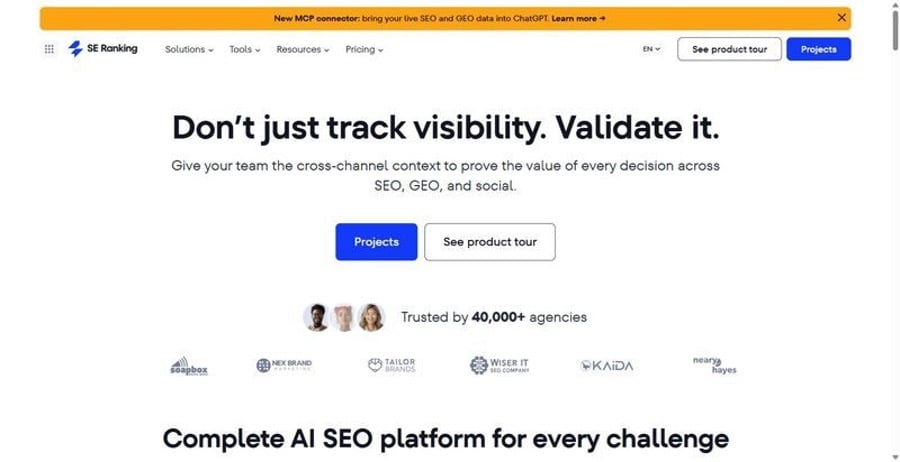
An all-in-one AI-powered SEO platform layering AI-search visibility over real rank, keyword, and audit data.
Best for: Agencies and in-house teams handling the AI-answer job and the classic SEO job in one place across dozens of clients.
Standout: Its AI Results Tracker measures brand mentions and links across Google AI Overviews, AI Mode, Gemini, Perplexity, and ChatGPT, caches the answers, and surfaces the sources they cite – so you see exactly why a competitor gets pulled into an AI answer and you don’t. That’s AI-search visibility tracking few suites match.
Pros:
- Mentions and links across 5 AI engines with cached answers and citation intelligence.
- AI on-page checker plus AI Writer and Content Editor grading against the top 10.
- API and MCP access on every plan.
- Recommendations mapped to live SERPs on real rank, keyword, audit, and backlink data.
Cons:
- Deeper LLM sentiment and cross-country benchmarking need the AI Search add-on and SE Visible.
- Caps AI prompts and research by plan (~100 prompts a day, 5 domains on Core).
- Covers so much that a one-job team ignores half of it.
Pricing: Core $129/mo ($103.20/mo billed annually), Growth $279/mo. AI Search add-on from $89/mo. 14-day free trial, no card.
Honest assessment: Marcus’s default for most agency and in-house teams – it does the AI-visibility job and the ranking job on one dataset, which few suites pull off. Caveat: to grind a single draft to its ceiling, a pure content optimizer goes deeper.
2. Surfer SEO
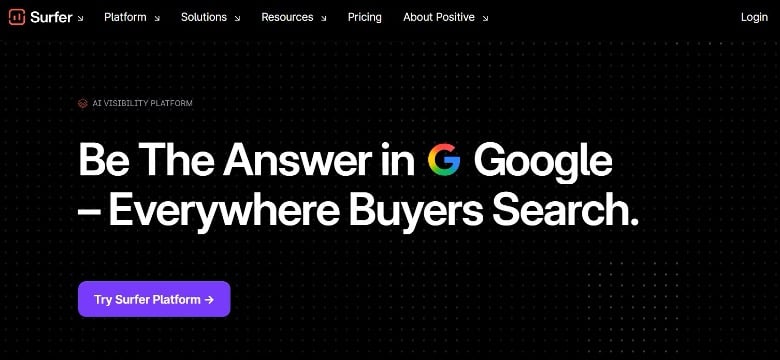
An on-page content optimizer, now with AI-search prompt tracking, that grades drafts against the live SERP in real time.
Best for: Teams shipping heavy content volume that want every piece to clear an on-page score before publish.
Standout: The Content Editor scores a draft as you write and maps NLP term coverage against the ranking pages, so writers stop guessing what “complete” means. Prompt tracking watches ChatGPT, Perplexity, and Google for whether your pages get named.
Pros:
- Grades content fast enough to fix a draft in one pass.
- Generates and humanizes AI copy inside the editor.
- Flags cannibalization and suggests internal links.
- Pulls term suggestions from the ranking SERP.
Cons:
- Multi-LLM visibility costs climb quickly at scale.
- Limits documents and tracked pages on lower tiers.
- Optimizes drafts but never tracks where you rank.
Pricing: Discovery $49/mo, Standard $99/mo, Pro $182/mo, billed yearly.
Honest assessment: Marcus keeps it as a content-optimization layer and nothing more. It earns its slot for grading and term coverage. Don’t mistake the new prompt tracking for a full platform – rank tracking and audit live elsewhere.
3. Frase
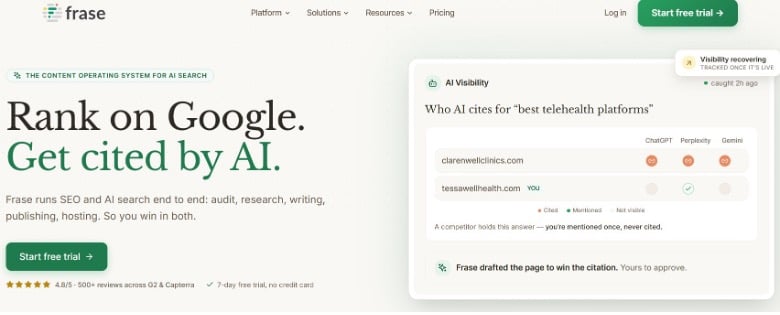
SERP-driven content research, brief-building, and drafting with GEO and AI-visibility monitoring bolted on top.
Best for: Teams that live in the research-to-brief step and measure themselves on turnaround speed.
Standout: Frase turns a query into a SERP-based brief and outline in minutes, pulling headings and questions from the winning pages. It then tracks answer coverage across ChatGPT, Google AI, Perplexity, Claude, and Gemini, widening LLM breadth by tier.
Pros:
- Builds briefs and outlines in minutes from live SERP data.
- Drafts competent first copy with the AI writer.
- Audits existing content for coverage gaps.
- Suggests internal links across your library.
Cons:
- Tightens article and audit-page quotas fast at volume.
- Locks the richest AI-visibility coverage behind the top tier.
Pricing: Starter $39/mo, Professional $103/mo, Scale $239/mo, billed yearly.
Honest assessment: A strong brief-and-draft engine, and Marcus buys it for that alone. The research-to-outline speed saves strategist hours; treat the AI-visibility layer as a bonus. If briefs are your bottleneck it pays off; if it’s tracking, look elsewhere.
4. Semrush
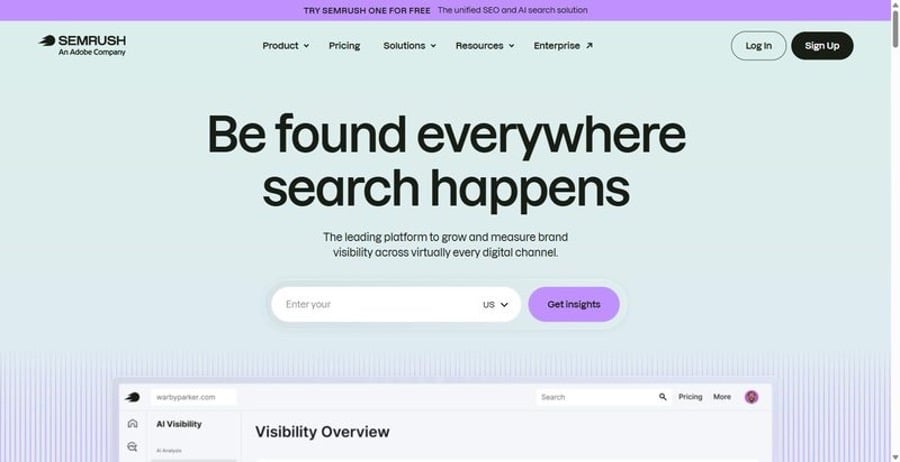
A full-stack SEO suite bolting its AI work onto three modules: a Content Toolkit, an AI Visibility Toolkit, and an assistant.
Best for: Teams already standardized on Semrush who want their AI features in the tool they open every day.
Standout: The AI Visibility Toolkit tracks custom prompts daily across ChatGPT, Google AI, Gemini, and Perplexity, with competitor research baked in, while ContentShake AI produces SEO-scored drafts.
Pros:
- One of the largest keyword and platform datasets available.
- SEO-scored articles through ContentShake AI.
- Branded and custom prompts across four AI engines daily.
- AI features inside a suite your team already runs.
Cons:
- Cost stacks fast across base plan, AI Visibility Toolkit, and Content Toolkit.
- Recently reorganized AI packaging, so pricing keeps shifting.
- Platform-tier prices before you reach the AI layer.
Pricing: Content Toolkit (ContentShake AI) $60/mo; AI Visibility Toolkit from $99/mo per domain; base plans $117–$456/mo billed annually.
Honest assessment: Fine if Semrush is already your system of record – broad data, useful prompt tracking. But stacking the base plan, the AI Visibility Toolkit, and the Content Toolkit gets expensive fast, and buying the whole suite just for the AI layer is a bad trade.
5. Clearscope
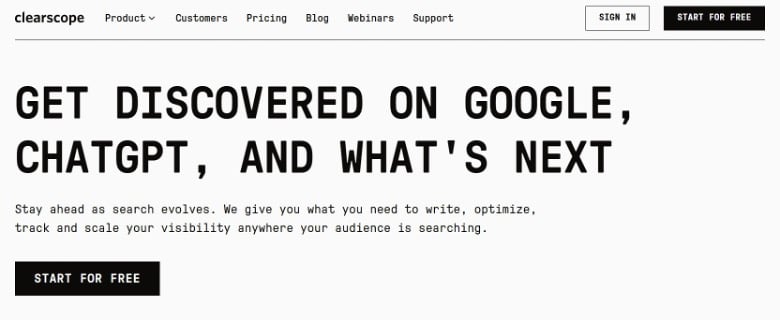
A premium content optimizer built around intent grading and positioning drafts for AI answers, not site-wide auditing.
Best for: Editorial teams that grade and sign off every draft to one consistent standard.
Standout: Grading is clean and intent-driven, with term coverage that maps to what actually ranks. It now tracks brand mentions across ChatGPT and Gemini and factors query fan-out into AI-answer readiness.
Pros:
- Grades drafts reliably against intent-weighted term coverage.
- Surfaces topic and keyword exploration for planning.
- Tracks brand mentions across ChatGPT and Gemini.
- The cleanest editor in the category.
Cons:
- Among the priciest per-seat content tools going.
- Caps exploration and draft credits tight on the lower tier.
- Optimizes content only. It won’t audit or track a site.
Pricing: Essentials $129/mo, Business $399/mo; 14-day trial.
Honest assessment: A defensible quality bar for editorial teams that sign off every draft and can absorb the per-seat cost. It won’t audit your site or track rankings – and if all you need is briefs, you’re paying a premium for a scorecard.
6. Writesonic
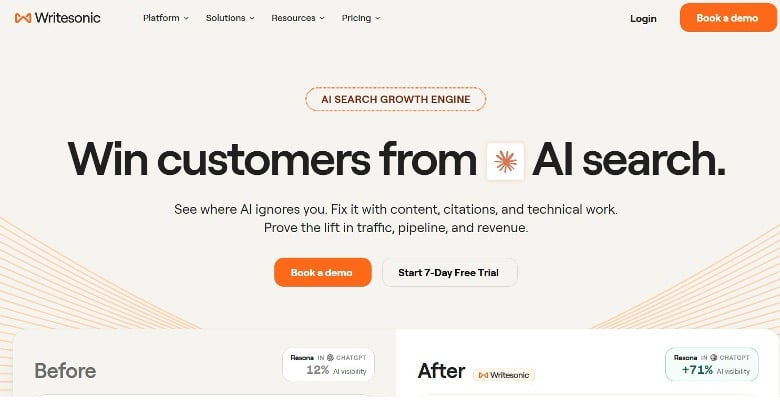
Rebuilt as an AI-search-visibility platform pairing bulk article generation with site audits and LLM/GEO tracking.
Best for: Teams producing AI articles at volume that also want AI-answer tracking in the same tool.
Standout: Bulk AI article generation runs alongside visibility tracking across ChatGPT, Gemini, and Google AI Overviews. Higher tiers add an Action Center that turns tracked gaps into on-page and off-page tasks. Throughput with a feedback loop.
Pros:
- Generates articles at high volume for content-hungry teams.
- Runs site audits alongside production.
- Tracks visibility across ChatGPT, Gemini, and Google AI Overviews.
- Adds sentiment analysis on higher tiers.
Cons:
- Reserves broadest LLM coverage and the full Action Center for Enterprise.
- Caps article output even on the Growth tier.
- Ships output that still needs a human editor.
Pricing: Starter $79/mo, Basic $199/mo, Growth $399/mo billed yearly.
Honest assessment: A volume play, and honest about it. If throughput is your constraint, it produces articles and tracks AI answers in one tool. Full coverage and the Action Center sit behind Enterprise, and caps bite even on Growth. Don’t let it publish unedited.
7. Alli AI
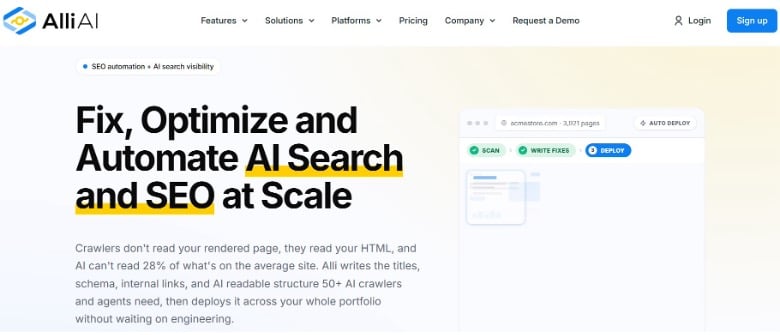
On-page and technical SEO automation that ships bulk changes and injects code across client sites without a rebuild or a dev queue.
Best for: Agencies that need on-page and technical changes live across client sites without waiting on dev teams.
Standout: Bulk on-page edits and code injection run CMS-agnostic, so you push title, meta, and schema changes at scale from one dashboard. It also pre-renders pages for 50-plus AI crawlers, with an LLM Mode showing your site the way those crawlers read it.
Pros:
- Push bulk on-page edits across sites from one dashboard.
- Deploy changes and inject code without a dev queue.
- Pre-render pages for 50-plus AI crawlers.
- Track site speed and keyword positions alongside the work.
Cons:
- Writes no content and builds no briefs (automation, not optimization).
- Requires a snippet install on every site.
- Priced at the agency tier.
Pricing: Business $249/mo, Agency $499/mo. 10-day trial.
Honest assessment: Buy it if implementation speed is your bottleneck and you’ve a backlog of on-page and technical fixes no dev team will touch this quarter. Skip it if you wanted content help – it writes nothing. That’s not what it’s for.
8. MarketMuse
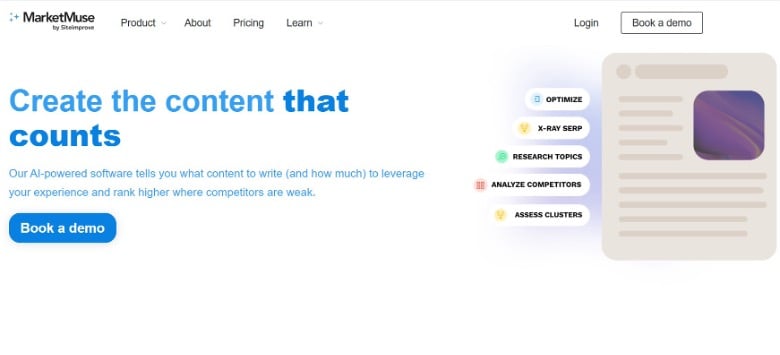
An AI content-planning platform built on topic modeling for coverage across large libraries, not one-page optimization.
Best for: Teams planning topical coverage across a big site, not optimizing a single page at a time.
Standout: Its proprietary topic modeling factors in your domain’s personalized difficulty and topic-authority scores, so recommendations reflect what you can actually rank for. Content-inventory analysis maps coverage and gaps across a whole domain, not one URL at a time.
Pros:
- Model topics with personalized difficulty and authority scores.
- Audit content inventory across an entire domain.
- Generate nine brief types for different content jobs.
- Run SERP and keyword analysis in the same workflow.
Cons:
- Gates paid pricing behind a demo (opaque tiers).
- Caps queries and briefs tightly on lower tiers.
- Steeper learning curve than a simple grader.
Pricing: Free tier (10 queries/mo). Paid Optimize/Research/Strategy by quote (historically around $149/mo for Optimize).
Honest assessment: The right pick if you plan topical coverage at scale and need to see the whole library at once. If you only grade one article at a time, it’s more platform than you’ll use, and the learning curve costs you a week before it pays off (budget for that).
9. Ahrefs
A research-led SEO suite that has bolted AI-era tooling onto deep backlink and keyword data.
Best for: Research-heavy teams adding AI-visibility tracking without leaving the tool they run their research in.
Standout: AI Content Helper handles AI-assisted grading, while Brand Radar tracks how often your brand shows up across AI answers – both on the backlink and keyword data underneath, so you track visibility without a separate tool.
Pros:
- Run deep backlink and keyword research.
- Grade content with AI Content Helper.
- Track brand mentions across AI answers via Brand Radar.
- Crawl and audit sites at scale.
Cons:
- Charges for Brand Radar as an add-on on premium plans.
- Ships no built-in long-form AI writer.
- Escalates in cost at the higher tiers.
Pricing: Lite $129/mo, Standard $249/mo. Brand Radar AI from $199/mo as an add-on.
Honest assessment: Strong research tool, and the AI features are additive rather than the reason to buy. Brand Radar is a paid add-on from $199/mo on top of already-premium plans, so the AI-visibility layer costs real money. No built-in long-form AI writer, either. Bring your own.
The Verdict
For most agency and in-house teams, SE Ranking is the pick. It handles the AI-answer visibility job and the ranking job on one dataset, so you stop stitching a stack together from three subscriptions that don’t talk to each other. That consolidation is the whole point. About 30% of US queries now trigger an AI Overview (SE Ranking research), and you can’t track that on a platform built only for blue-link positions.
One nuance: a content optimizer like Surfer or Clearscope goes deeper on a single draft than SE Ranking. If your bottleneck is one high-stakes page, that depth earns its seat.
Skip if: Don’t default to Clearscope when what you need is site-wide visibility tracking across a client portfolio. Don’t default to Alli AI unless you have the implementation bottleneck its automation solves. Enterprise pricing for a problem you don’t have is waste.
Shortlist two or three. Run them on one real client for a month before you commit budget.
Frequently Asked Questions
Are AI SEO tools worth it for agencies?
Yes, when they replace manual work across many clients. The return is consolidation and AI-answer visibility, not novelty. AI summaries roughly halve click-through, 8% versus 15% (Pew Research), so tracking where you surface in AI answers is now a core reporting line, not an experiment.
Can AI SEO tools replace an SEO specialist?
No. They compress the work. A tool drafts briefs, scores on-page elements, flags technical issues, and pushes bulk fixes. It does not set strategy, weigh a client’s risk tolerance, or catch the hallucinated claim before it publishes. Strategy, judgment, and QA stay human. Treat the tool as a force multiplier for execution, not a replacement for the person directing it.
Do AI SEO tools help you get cited in AI Overviews?
The tracking ones show which sources AI engines cite and where you’re absent. That gap is the input to earning citations: you see who gets pulled into the answer, then build the content and authority to displace them. SE Ranking tracks this, as do Semrush and Ahrefs. Visibility data first, citation strategy second.
AI SEO tool vs traditional SEO platform, what’s the difference?
Traditional platforms track rankings, backlinks, and site audits. AI SEO tools add content generation, on-page automation, or AI-answer visibility on top. The strongest option is an ai powered seo platform that does both, so your ranking data and your AI-visibility data live in one place instead of two dashboards you reconcile by hand.