
Beyond the Screen: How AI 3D Is Expanding the Toolkit for Digital Content Creators
Digital content has become increasingly visual.
A short video may need an eye-catching prop. A social media post may benefit from an unusual visual. A promotional campaign might need a virtual scene. Even a simple presentation can become more engaging when it includes something that viewers can explore from multiple angles.
For content creators, this creates an interesting challenge.
There are countless possibilities for visual content, but producing those visuals often requires different tools and specialized skills. Photography, illustration, video editing, graphic design, animation, and 3D modeling each involve their own workflows.
3D can be particularly demanding.
Creating a usable 3D asset from scratch traditionally takes time, especially when the creator is primarily focused on storytelling rather than modeling.
AI-powered 3D tools are beginning to change that relationship.
Instead of treating 3D as a specialized production stage reserved for professional modelers, creators can increasingly use it as another element in their everyday content toolkit.
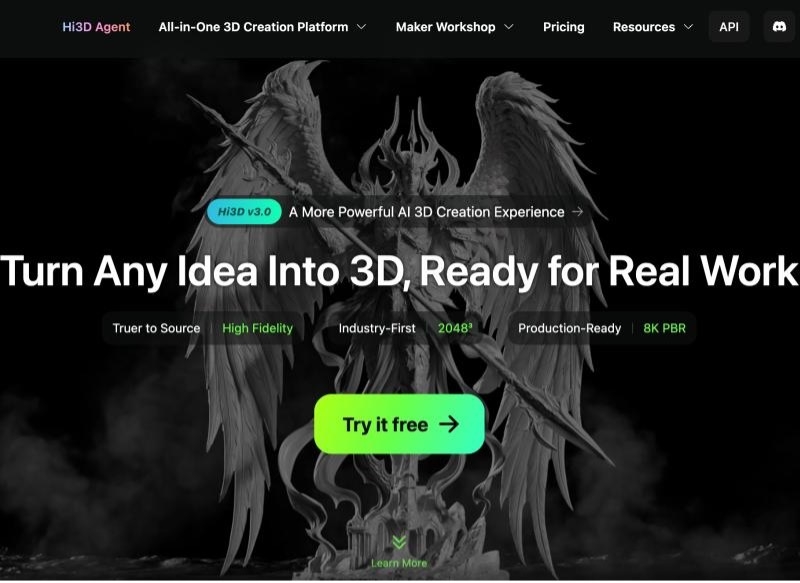
Hi3D provides one example of a 3d model AI generator, combining AI 3D generation with texture creation, stylized appearance, relief generation, and other tools that can help creators develop visual assets for different kinds of digital projects.
3D as a New Content Format
Most digital content is designed to be consumed from a fixed viewpoint.
A photograph shows one composition.
An illustration has one canvas.
A video controls what the audience sees and when they see it.
A 3D asset introduces another possibility: the object itself can become the visual subject.
Instead of showing viewers one predetermined angle, creators can use the model as a flexible visual element.
It can be rotated, repositioned, placed into different scenes, or rendered from multiple perspectives.
That flexibility can be useful when the same asset needs to appear in several pieces of content.
A creator might use one object in a product-style video, a social media graphic, and a virtual scene without having to recreate the underlying visual concept every time.
Turning Visual Ideas Into Content Assets
Content creators often start with something much simpler than a finished 3D model.
It might be a sketch, a photograph, a reference image, or an illustration.
The challenge is turning that initial idea into something that can be reused across different formats.
Image-to-3D generation provides one possible bridge.
With Hi3D, creators can use an image as the starting point for an online 3D model maker, generating a 3D model from a single-view image or using multiple views to provide additional visual information when available.
This can be particularly useful during the early stages of content production.
Instead of waiting until the end of a project to determine whether a 3D asset is necessary, creators can experiment with one relatively quickly and see whether it improves the visual concept.
Creating More Interesting Social Media Visuals
Social media rewards content that immediately attracts attention.
Creators therefore experiment constantly with unusual compositions, visual effects, and recognizable objects.
3D can add another dimension to that experimentation.
A digital object can be placed against different backgrounds, shown from unusual perspectives, or incorporated into a short animation.
A familiar visual can suddenly feel different simply because the camera is no longer restricted to a flat image.
For creators who publish frequently, reusable 3D assets can also become part of a visual identity.
Instead of producing every graphic independently, they can build a collection of objects that appear repeatedly across different posts.
Over time, those assets can become recognizable elements of a creator’s style.
Building Virtual Scenes Without Starting From Zero
Another useful characteristic of 3D assets is that they can be moved.
A 2D image is closely tied to its original composition.
A 3D model is more flexible.
Once an object exists in three dimensions, it can potentially be positioned inside different digital environments.
This is useful for creators who work with virtual scenes.
A content creator might want to build a simple room for a video. Another might need a collection of objects for an animated sequence. Someone creating educational or promotional content may want to visualize an environment that would be difficult to photograph in reality.
In each case, the 3D asset becomes a building block.
The creator does not necessarily need to model every object manually.
Giving One Asset Multiple Visual Styles
A digital asset does not always need to look realistic.
Depending on the content, a stylized appearance may work better.
A playful social media channel might prefer exaggerated materials. A creative campaign might use an illustration-inspired visual language. A virtual environment could require a consistent artistic style rather than photorealism.
This is where texture becomes more than a technical detail.
Hi3D supports both realistic and stylized texture generation, allowing creators to explore different visual treatments for their models.
The same basic object can therefore support different types of content.
Its geometry provides the structure, while its surface treatment can help determine the mood.
Creating Content Around the Object Itself
Traditional content production often starts with a story and then looks for visuals to support it.
3D can also work in the opposite direction.
A creator might discover an interesting object first and then build content around it.
For example, an unusual digital asset could become the centerpiece of a short video. A collection of objects could inspire a themed social media series. A generated model could become part of a visual experiment.
This creates a more exploratory style of content creation.
The asset is no longer simply an illustration of an existing idea.
It can become the idea.
A Different Way to Approach Video Production
Video creators are constantly looking for ways to make visual sequences more dynamic.
Physical filming has obvious limitations. The available locations, objects, lighting, and camera angles all affect what can be captured.
Digital 3D assets offer a different environment.
Once the object exists digitally, creators can experiment with camera positions and compositions without physically moving the object.
They can also reuse the same asset in multiple scenes.
This does not mean 3D should replace live-action footage. In many projects, combining real and digital elements can produce more interesting results.
A physical video can provide realism, while 3D assets can provide visual elements that would otherwise be difficult to create.
The Role of 3D in Brand Content
Brands also need a constant supply of visual content.
A campaign may require images, videos, website graphics, advertisements, social posts, and promotional materials.
Creating a reusable collection of digital assets can make visual production more flexible.
For example, a brand could develop digital versions of selected objects or visual elements and then use them in different compositions.
The advantage is not simply reducing production time.
Consistency also matters.
When the same digital asset appears across several pieces of content, it can help create a stronger connection between them.
AI 3D tools can therefore be considered not only as generation systems but also as tools for developing reusable visual resources.
Exploring Concepts Before Investing in Production
There is another situation where AI 3D can be useful: pitching ideas.
A creator may have a concept for a campaign but not yet know whether the visual direction will work.
Producing a fully finished animation or commercial at this stage may be unnecessary.
A rough 3D asset can provide something concrete to show.
The team can discuss the composition, appearance, scale, and overall concept before committing to more expensive production work.
This makes 3D useful as a visualization medium.
It allows abstract ideas to become visible early enough for other people to react to them.
Making Content More Interactive
3D also has a natural connection with interactive media.
Unlike a static image, a 3D asset can potentially become part of an interactive experience.
Users can rotate objects, move around environments, inspect details, or interact with digital scenes.
This can be relevant to websites, virtual experiences, games, product showcases, educational projects, and other forms of interactive content.
Not every creator needs to build a full interactive application.
Even simple 3D elements can change the way an audience experiences a piece of content.
The important shift is from looking at an image to exploring an object.
Creating Visual Assets From Existing Content
Many creators already have years of accumulated visual material.
There may be old illustrations, photographs, concept sketches, logos, or other graphics sitting on hard drives and cloud storage.
Some of these assets may no longer be used in their original form.
AI 3D tools provide another way to revisit them.
An old image can become the starting point for a new digital object. A previous illustration can inspire a different visual treatment. A familiar graphic can become part of a new content format.
This does not mean every old asset should be converted into 3D.
Instead, it gives creators another option when looking for ways to reuse existing material.
3D Can Connect Different Creative Disciplines
One reason 3D is interesting for digital creators is that it sits between several creative fields.
It can be used in graphic design.
It can appear in video.
It can support animation.
It can contribute to interactive media.
It can be exported for physical production.
This makes a 3D asset unusually flexible.
A creator who normally works in one medium can use the same object as a starting point for another.
That flexibility becomes even more useful when AI reduces some of the technical barriers involved in creating the initial asset.
Keeping the Creator in Control
As with any AI-assisted creative technology, generation is only the beginning.
A model may provide a useful object, but the creator still needs to decide how that object should be used.
Which angle works best?
Where should it appear?
What visual style fits the content?
Does it support the story?
Should it be realistic or stylized?
Should it appear alone or as part of a larger scene?
These are creative decisions rather than technical ones.
AI can provide the raw material.
The creator determines what that material means.
This distinction is especially important in content creation because a technically impressive asset does not automatically make compelling content.
Context still matters.
Building a Personal Library of Digital Assets
For creators who produce content regularly, one of the longer-term opportunities is building a personal 3D asset library.
Instead of generating something only when a project requires it, creators can collect useful models over time.
Some may come from photographs. Others may originate from illustrations or entirely new concepts.
The library can gradually become a resource for future projects.
A creator might need a certain object months later and already have a suitable digital asset available.
This changes AI 3D from an occasional experiment into part of a broader content-production system.
The Future Content Toolkit May Be More Three-Dimensional
Content creation has always expanded whenever new visual tools became accessible.
Digital cameras changed photography.
Editing software changed video.
Graphic design software changed visual communication.
AI-generated imagery introduced another way to create visual material.
AI 3D adds another possibility: making spatial content easier to produce and reuse.
Hi3D brings together image-based 3D generation with tools for textures, stylized appearance, reliefs, and model preparation, giving creators different ways to experiment with three-dimensional content.
The significance is not that every piece of digital content needs to become 3D.
Most content will remain a mixture of photographs, text, graphics, video, and other formats.
But creators now have another option when a flat image is not enough.
A digital object can move between scenes, styles, formats, and projects.
It can become a prop, a visual element, an interactive asset, or simply a new way to present an idea.
For today’s content creators, that flexibility may be the most valuable part of bringing 3D into the everyday creative toolkit.