
$70,000 Salary in New York: What Is Your Actual Take-Home Pay?
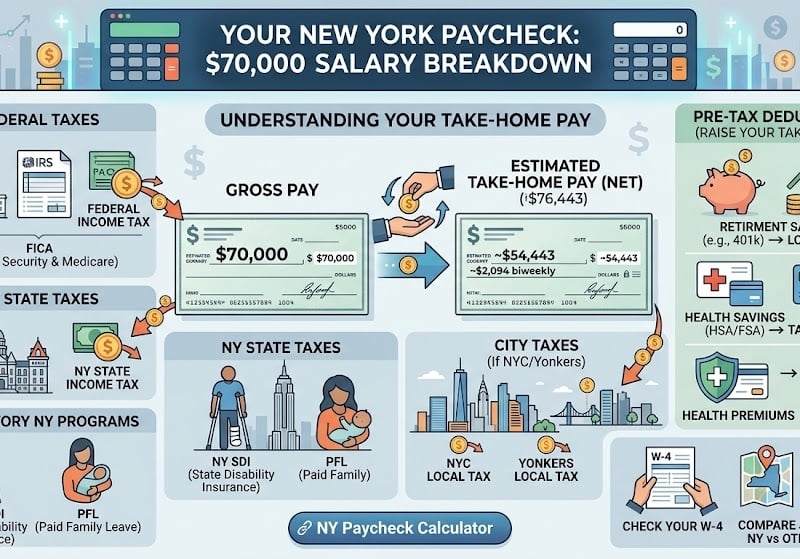
Accepting a $70,000 salary offer in New York can feel like a major milestone, but the amount that actually lands in your bank account will look noticeably different from your gross compensation. Between federal taxes, FICA withholdings, state-level assessments, and mandatory state programs, living in New York requires a clear understanding of payroll deductions.
Before budgeting for rent, groceries, or entertainment, it helps to run the numbers using a reliable New York paycheck calculator to see how gross income translates to net pay.
Why Take-Home Pay in New York Is Lower Than in Many Other States
When you evaluate a job offer in New York State, you are dealing with one of the higher tax burdens in the country. While state income taxes across the U.S. range from zero to double digits, New York enforces a progressive state income tax structure with top marginal rates that can reach up to 10.9%.
If you live or work in New York City or Yonkers, you must also account for additional local income taxes. For example, NYC levies its own personal income tax on top of the state tax, adding roughly 3% to 3.8% to your overall tax liability. Even outside the city limits, state-mandated benefit programs and statutory taxes further reduce your final check compared to states like Florida, Texas, or Washington, which charge zero state income tax.
What Comes Out of Your Paycheck?
To understand your total deductions, it helps to dissect the primary components withheld from every paycheck in New York:
- Federal Income Tax: Withheld according to IRS tax brackets based on your filing status, total gross income, and how you completed your IRS Form W-4.
- Social Security and Medicare (FICA): Under the Federal Insurance Contributions Act, 6.2% of your income is deducted for Social Security up to the annual wage cap, alongside 1.45% for Medicare, totaling a mandatory 7.65% FICA withholding.
- New York State Income Tax:New York taxes personal income on a progressive scale. For middle earners, marginal rates typically fall between 4% and 5.5%. You can verify detailed guidance directly on the New York State Department of Taxation and Finance website.
- State Disability Insurance (SDI) and Paid Family Leave (PFL):New York mandates coverage for temporary disability and family leave.Employers may withhold up to 60 cents per week for SDI, while PFL is funded through a small payroll deduction capped annually by the state.
Breakdown Example: $70,000 Salary for a Single Filer
To see how these deductions work in practice, consider a standard scenario: a single filer living in New York State (outside New York City) earning $70,000 annually, paid on a biweekly schedule (26 paychecks per year) with no pre-tax benefit contributions.
Using an accurate New York salary calculator yields the following estimated figures for an annual wage of $70,000:
| Category | Annual Amount | Biweekly Amount |
| Gross Pay | $70,000.00 | $2,692.31 |
| Federal Income Tax | ~$6,850.00 | ~$263.46 |
| FICA Taxes (Social Security & Medicare) | $5,355.00 | $205.96 |
| New York State Income Tax | ~$3,050.00 | ~$117.31 |
| NY SDI & Paid Family Leave | ~$302.00 | ~$11.62 |
| Total Estimated Deductions | ~$15,557.00 | ~$598.35 |
| Estimated Net Take-Home Pay | ~$54,443.00 | ~$2,093.96 |
In this scenario, your effective total tax and mandatory contribution rate is approximately 22.2%. On a biweekly basis, you can expect around $2,094 in take-home pay out of a $2,692 gross check.
(Note: If you reside in New York City, an additional city tax of roughly $2,100 annually will reduce your biweekly paycheck by another $80 to $85.)
How Pre-Tax Deductions Can Lower Taxes and Protect Income
While payroll taxes are unavoidable, you can lower your tax obligation by using pre-tax deductions. Lowering your taxable gross income reduces both federal and state income tax burdens.
1. Traditional 401(k) / 403(b) Retirement Plans
Contributions made to a traditional employer-sponsored retirement plan are subtracted from your gross pay before income taxes are calculated. If you contribute 5% ($3,500 annually) on a $70,000 salary, your federal and state taxes are calculated on $66,500 instead.
2. Health Savings Accounts (HSAs) and Flexible Spending Accounts (FSAs)
HSAs and FSAs let you set aside money pre-tax for medical, dental, vision, and child-care expenses. You reduce your overall tax bill while paying for predictable out-of-pocket medical needs.
3. Pre-Tax Health Insurance Premiums
Paying your health, dental, and vision insurance premiums through payroll deductions using a Section 125 cafeteria plan lowers your taxable income for federal, state, and FICA taxes.
Example Impact: Contributing $300 a month toward health insurance and $200 a month to a 401(k) reduces your annual taxable income by $6,000. This shift can save hundreds of dollars each year in federal and New York state taxes while building your financial cushion.
Key Tips for Managing Your New York Take-Home Pay
Review Your W-4 Withholdings Regularly
Whenever your life circumstances change—such as getting married, taking on a second job, or adjusting your personal deductions—update your IRS Form W-4. Guidelines and tools on the official IRS website can help you set accurate withholding rates to avoid underpayment penalties or large end-of-year tax refunds that amount to interest-free loans to the government.
Account for State and Local Differences When Evaluating Job Offers
A $70,000 salary in New York State does not offer the same purchasing power or net pay as a $70,000 salary in Texas, North Carolina, or Ohio. When comparing job offers across different states or cities, always look past the headline gross salary. Plug the offer details into an online NY paycheck calculator to evaluate what you will clear after state and local taxes, and factor in cost-of-living differences like housing and transportation before signing an employment contract.