
7 best Amazon PPC agencies for CPG brands
This guide ranks the 7 best Amazon PPC agencies for CPG brands in 2026, evaluated on CPG-specific experience, catalog management capability, optimization frequency, technology, and cross-channel integration.
Managing Amazon PPC for a CPG brand with 50-plus SKUs looks nothing like managing a 10-product catalog. Budget allocation gets buried in blended metrics across multiple campaigns, and a weekly optimization review lets misallocated spend go undetected for days before anyone catches it.
Most Amazon PPC agencies run the same playbook regardless of client SKU count. That approach breaks down fast once you’re managing hundreds of campaigns across product lines, each with its own margin, seasonal curve, and Subscribe & Save dynamic.
This guide ranks the 7 best Amazon PPC agencies for CPG brands on CPG-specific experience, large-catalog management, optimization frequency, technology, and cross-channel integration.
What makes Amazon PPC different for CPG brands?
Amazon PPC presents challenges for CPG brands that smaller catalogs don’t face. Here’s what creates the complexity.
High SKU counts create campaign management complexity
A CPG brand with 100-plus ASINs will run anywhere from 300 to 500-plus active campaigns. Each ASIN carries its own margin, conversion rate, and competitive intensity, which makes manually adjusting bids at that scale nearly impossible.
Once a brand has too many campaigns to actively adjust and optimize weekly, a large portion of the catalog runs on autopilot for days at a time. Budget ends up disproportionately weighted toward top-selling SKUs, while profitable long-tail SKUs get little to no spend and never grow.
Amazon’s blended ACoS number creates a false sense of security. It hides the real per-ASIN profitability problems underneath.
Subscribe & Save changes the LTV math
Repeat business is the core of CPG economics. Customers who subscribe to a CPG brand’s products through Amazon’s Subscribe & Save program carry meaningfully higher lifetime value than one-time buyers, and that changes how you should bid on keywords.
If ACoS is your primary efficiency KPI, you’re likely under-bidding on keywords that drive Subscribe & Save conversions and over-bidding on keywords that drive one-time purchases with low repeat rates. The right Amazon PPC agency for CPG brands tracks Subscribe & Save conversion rate by ASIN and factors customer LTV into bidding strategy alongside first-order profitability.
Seasonality and category competition demand daily attention
CPG categories like health and wellness, food and beverage, and personal care see sharp seasonal demand swings. Back-to-school, holiday gifting, Prime Day, and category-specific cycles like cold and flu season or summer skincare all shift the competitive landscape within days, not weeks.
A weekly optimization review can’t respond fast enough. By the time an agency catches a budget misallocation or a competitor’s aggressive bidding push, you’ve already lost share of voice during the highest-value days of the cycle.
1. Olifant Digital: best Amazon PPC agency for CPG brands scaling profitably
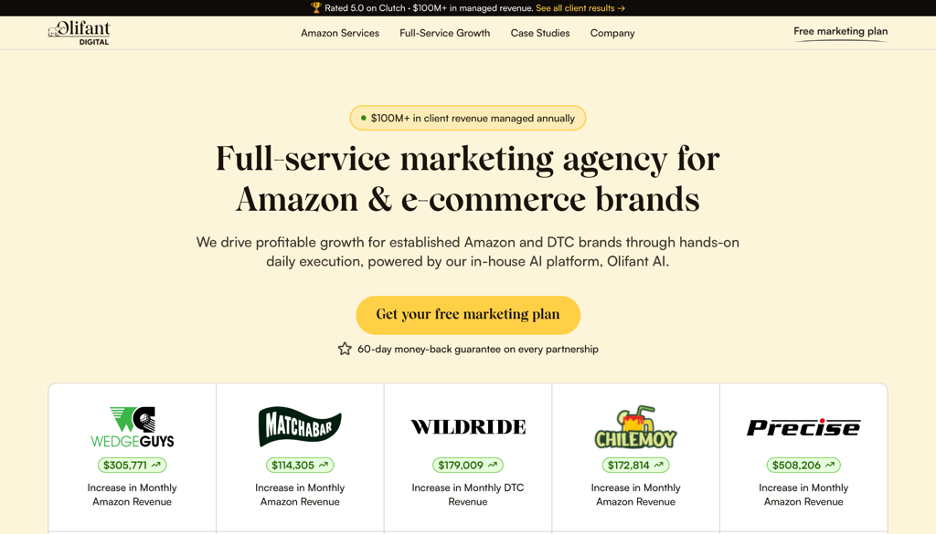
Overview: Olifant Digital is a full-service Amazon agency for established e-commerce brands that want profitable growth. The Amazon team runs overall strategy, daily PPC optimization, creative development, listing optimization, and business forecasting.
Olifant Digital also offers Meta and Google ad buying, email and SMS retention, CRO, and e-commerce SEO, making it a strong fit for CPG brands selling on both Amazon and their own DTC website.
Olifant Digital treats Amazon as a strategically managed, brand-aligned profit engine. Communication runs through a dedicated Slack channel throughout the day and a weekly call to review results and set direction.
Olifant Digital’s in-house AI platform, Olifant AI
What sets Olifant Digital apart is its in-house AI platform, Olifant AI, built specifically to manage large-scale CPG catalogs at a level of precision manual workflows can’t match. Here’s what it does:
- Automates bid management across large catalogs. Instead of a media buyer manually adjusting bids one campaign at a time, Olifant AI uses performance data across the entire catalog to adjust bids on an ASIN-by-ASIN basis, so every SKU gets the right level of daily spend, not just the top performers.
- Tracks TACoS per ASIN. Where most agencies report blended TACoS across an entire account, Olifant AI tracks TACoS at the individual ASIN level, showing which products are actually profitable after ad spend and which ones are dragging on margin.
- Analyzes Subscribe & Save conversion. Beyond first-order conversion analysis, Olifant AI identifies which keywords, match types, and placements drive the strongest Subscribe & Save conversion rates, building toward recurring revenue rather than one-time sales.
- Flags budget misallocation in real time. When a campaign overspends relative to conversion rate, or budget sits idle on an underperforming segment, Olifant AI flags it immediately rather than waiting for the next weekly review.
Results:
- Beauty by Earth: +27% revenue in 30 days across 100+ ASINs, driven by a tiered ASIN management approach where high-potential SKUs get aggressive bid targets, maintenance SKUs are managed for profitability, and new launches follow a separate ramp-up cadence.
- Ekster: $688,406 in added yearly Amazon profit.
- Wedge Guys: $305,771 per month in added revenue, +391% growth.
- MatchaBar: $114,305 per month in added revenue.
Services:
- Amazon PPC management and strategy through its in-house AI platform, Olifant AI
- Listing optimization and creative strategy
- Business forecasting
- Meta and Google ad buying
- Email and SMS retention
- Conversion rate optimization
- E-commerce SEO
Pricing: Starts at $2,000 per month, flat retainer, based on catalog size and complexity. No percentage-of-spend fees. Every engagement is backed by 60-day money-back guarantee on management fees.
Best fit for: Established Amazon CPG brands with 50+ SKUs that want a profit-focused, tech-enabled Amazon partner, with the option to integrate broader DTC marketing.
2. AMZ Pathfinder: best for mid-sized Amazon sellers
Overview: AMZ Pathfinder focuses on Amazon PPC management, Amazon DSP, and Google Ads built to drive external traffic to Amazon listings.
Based on client case studies across US and European Amazon marketplaces, the agency has built a reputation among mid-size sellers for growing revenue through multi-marketplace campaign management (based on publicly available information).
Beyond standard Sponsored Products, Sponsored Brands, and Sponsored Display campaigns, AMZ Pathfinder uses Amazon DSP to reach potential customers earlier in the shopping journey, and runs Google Ads campaigns designed to send external traffic to Amazon listings, which can help organic rank.
Key strengths:
- Multi-marketplace capability. Demonstrated results across US and European marketplaces (based on publicly available information).
- DSP capability. Custom audiences based on shopper behavior, useful for retargeting shoppers who visited a listing without purchasing.
- Google Ads for Amazon traffic. Google Shopping and Search campaigns directed at Amazon listings to support organic rank.
Services: Amazon PPC (Sponsored Products, Brands, Display), Amazon DSP, Google Ads for Amazon traffic, multi-marketplace campaign management.
Considerations for CPG brands: AMZ Pathfinder’s multi-region experience is an advantage for CPG brands expanding internationally, and its DSP capability adds a useful layer of demand generation in saturated categories.
Best fit for: Mid-range CPG sellers generating $500,000 to $5 million in Amazon sales that want to enter new marketplaces and add DSP to their advertising mix.
3. Nuanced Media: most comprehensive full-service Amazon agency for CPG
Overview: Nuanced Media combines advertising management with retail-readiness services: listing optimization, A+ Content development, and Brand Store design.
For CPG brands, Nuanced Media’s focus on getting listings ready before advertising spend ramps up matters. Running paid traffic to a weak listing wastes budget, and Nuanced Media’s process addresses that gap directly.
Key strengths:
- Retail readiness first. Listings, images, A+ Content, and Brand Store get optimized before PPC scales, improving the ROI of every paid click.
- CPG experience. Works across multiple consumer goods categories.
- Full-service, single point of contact. Handles listing creation, optimization, A+ Content, and Brand Store design under one roof.
Services: PPC advertising optimization and management, listing optimization and A+ Content development, Brand Store design, Amazon account management.
Considerations for CPG brands: Brands still building out their Amazon presence benefit most from this listing-first model, since stronger listings compound the return on every ad dollar spent afterward.
Best fit for: CPG brands that need help with both paid advertising and the operational side of their Amazon presence, including brands launching new products or expanding their catalog.
4. Clickstera: top choice for multi-channel CPG growth
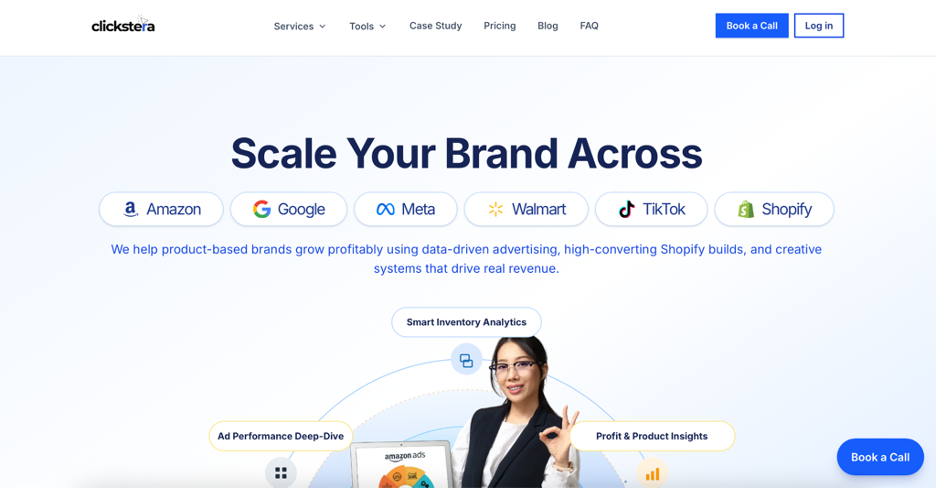
Overview: Clickstera manages advertising across Amazon, Walmart, Meta, and Google, positioning itself as a multi-channel partner for brands selling both DTC and on marketplaces.
Many CPG brands sell on Amazon and Walmart while also running DTC operations on Shopify. A single agency managing paid strategy across all of these channels can reduce the coordination overhead of managing messaging and bidding separately.
Key strengths:
- True multi-channel management. Amazon, Walmart, Meta, and Google under one roof, with coordinated budget allocation across channels.
- Walmart marketplace expertise, less common among Amazon-only agencies.
- Framework-based approach for developing, testing, and scaling campaigns consistently.
Services: Amazon PPC, Walmart Marketplace advertising, Meta Ads, Google Ads (Search, Shopping, Performance Max), multi-channel strategy development.
Considerations for CPG brands: A multi-channel view matters when customers discover a product on one platform and buy on another. Clickstera’s cross-channel visibility helps route budget toward the actual conversion point.
Best fit for: CPG brands selling on Amazon and Walmart while running Meta and Google ads, that want one agency overseeing the full cross-platform picture.
5. Channel Key: best for enterprise CPG product catalogs
Overview: Channel Key is a commerce acceleration agency built for brands managing large SKU catalogs across Amazon and other retail channels, supporting growth through advertising, content creation, and strategic planning.
For CPG brands running thousands of ASINs across multiple categories, Channel Key’s enterprise-focused approach is built for that scale.
Key strengths:
- Enterprise-scale Amazon management for brands with hundreds of ASINs.
- Big-catalog management, including large-scale campaign portfolios and tiered budget allocation.
- Category-specific strategy built around each category’s margin and competitive profile.
Services: Amazon PPC, catalog optimization, Amazon DSP, brand strategy and positioning, retail channel acceleration.
Considerations for CPG brands: Channel Key’s category-specific strategy work is especially useful for CPG brands spanning multiple product categories with different margin profiles and competitive dynamics.
Best fit for: Enterprise CPG brands with large, multi-category catalogs that need an agency built for scale and strategic complexity.
6. Ad Badger: best for smaller CPG brands
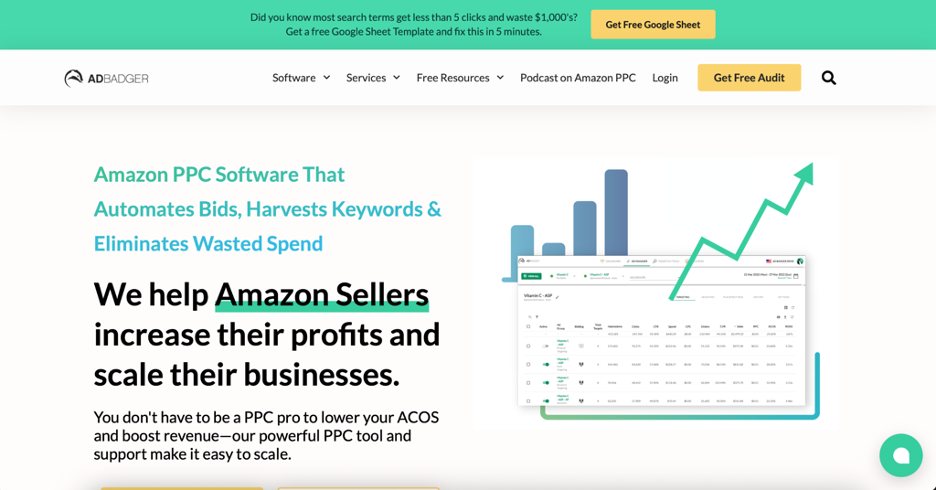
Overview: Ad Badger combines Amazon PPC management software with optional managed services. The software handles automated bid adjustment, flags wasteful spend, and provides campaign analysis, while the managed services team can take over full campaign management when a brand wants hands-off support.
This hybrid model gives smaller CPG brands a cost-effective starting point: run the software independently, then add managed services as the catalog and budget grow.
Key strengths:
- Software plus services hybrid, letting brands scale their engagement as they grow.
- Educational content (blog, podcast, guides) covering Amazon PPC fundamentals.
- Automated, rule-based bid management for baseline optimization without manual input.
Services: Amazon PPC software (automated bids, analytics, wasteful spend detection), managed PPC services, campaign audits, educational resources.
Considerations for CPG brands: The software-first model fits best under roughly 30 SKUs with modest ad spend. As SKU count and complexity grow, brands typically need to shift toward full-service management, and Ad Badger’s hybrid model allows that transition in stages.
Best fit for: Small CPG brands with $100,000 to $1 million in Amazon sales that want to start with software-driven PPC management and add agency support as they scale.
7. Tinuiti: best for enterprise CPG with large budgets
Overview: Tinuiti is an independent performance marketing agency specializing in Amazon and marketplace advertising, working with enterprise brands across retail media networks.
The agency’s full-funnel attribution capability is built for scale that most mid-sized agencies can’t match, giving large CPG brands with seven-figure monthly ad budgets the reporting structure and strategic depth to manage complex, multi-marketplace advertising programs.
Key strengths:
- Full-funnel attribution, connecting upper-funnel awareness (DSP, Sponsored Brands Video) to lower-funnel conversion for a complete view of what’s driving revenue.
- Amazon DSP at scale, using custom audience segmentation, sequential messaging, and cross-device targeting.
- Multi-marketplace coverage across Amazon and other retail media networks, useful for CPG brands selling through multiple retailers.
- Proprietary measurement tools supporting incrementality testing and media mix modeling (based on publicly available information).
Services: Amazon PPC and DSP, retail media network advertising, full-funnel measurement and attribution, creative development, strategic consulting.
Considerations for CPG brands: Tinuiti is built for scale. Brands investing heavily in Amazon advertising across multiple retail media networks are the right fit, though enterprise agencies generally require a larger investment of time and money than more agile, tech-enabled partners.
Best fit for: Enterprise CPG brands with over $500,000 per month in Amazon ad spend that need full-funnel attribution, multi-marketplace reach, and a large team of specialists.
How to choose the best Amazon PPC agency for your CPG brand
Choosing the wrong Amazon PPC agency costs more than the management fee. It costs weeks of lost momentum, wasted ad spend, and market share.
Do they have experience with CPG brands? E-commerce experience alone doesn’t mean CPG expertise. Ask how many CPG brands they currently manage, which categories, and whether they understand the differences between marketing shelf-stable and perishable products. An agency with real CPG experience already understands how category competition, Subscribe & Save, and seasonal demand affect campaign design, instead of learning it on your account at your expense.
What’s their optimization cycle? Optimization cadence is likely the biggest difference between agencies. A weekly review cycle leaves campaigns unmonitored for 5 to 6 days at a stretch, which is too long for a CPG brand running over 100 SKUs and hundreds of campaigns at once. Ask how often the agency actually reviews and adjusts campaigns. Daily optimization, especially powered by tools like Olifant Digital’s in-house AI platform, Olifant AI, catches budget misallocation, bid drift, and competitive shifts before they erode margin.
Will they provide per-ASIN data? Blended ACoS or TACoS across your whole account means you’re making decisions blind. Request a sample report and confirm it includes TACoS per SKU, ad-attributed revenue, organic revenue, and contribution margin. If an agency can’t produce that level of detail, their reporting wasn’t built for a CPG catalog’s complexity.
Can they integrate your other channels? Most CPG brands sell beyond Amazon. If you run a DTC website, Meta ads, or Google ads, your Amazon PPC strategy shouldn’t operate in isolation. An agency that manages or integrates with your other channels prevents budget cannibalization, coordinates messaging, and gives you full visibility into customer acquisition cost.
Can they leverage their own technology? The tools an agency builds tell you what they’re capable of. Custom-built technology, like Olifant Digital’s in-house AI platform, Olifant AI, signals investment in solving specific problems no off-the-shelf tool addresses.
Frequently asked questions
What is an Amazon PPC agency?
An Amazon PPC agency manages your sponsored product, brand, and display advertising on Amazon, handling keyword research, campaign structure, bidding, and ongoing optimization so you can focus on product development, supply chain, and the rest of your business. Many agencies that specialize in CPG also manage Amazon DSP as part of a comprehensive advertising plan.
How much does Amazon PPC management cost for CPG companies?
Cost structures typically fall into a fixed percentage of ad spend, a flat monthly retainer, or a hybrid model combining a retainer with performance-based compensation. Pricing varies based on catalog size and ad spend, so it’s worth comparing proposals across a few agencies. The right benchmark isn’t the lowest price, it’s whether the agency’s efficiency gains generate incremental profit that clearly exceeds their fee.
What’s the difference between ACoS and TACoS?
ACoS measures ad spend against ad-attributed sales only. TACoS measures total ad spend against total revenue, including both organic and ad-attributed sales, which makes it the more relevant metric for evaluating overall advertising effectiveness. A declining TACoS alongside rising total revenue signals a positive halo effect on organic rank and category visibility.
How quickly will I see results from an Amazon PPC agency?
Most CPG companies see measurable improvement within 1 to 2 months. The first 30 days typically go toward establishing optimal account structure, cleaning up keyword sets, and implementing bid strategy. By months 2 and 3, once enough data has accumulated, clients typically see TACoS decline alongside rising top-line revenue. AI-powered tools like Olifant Digital’s in-house AI platform, Olifant AI, can accelerate that timeline.
Should CPG companies use Amazon DSP alongside Sponsored Product campaigns?
Yes. Sponsored Product campaigns reach buyers who’ve already shown interest in your product type. Amazon DSP builds demand further upstream by targeting shoppers based on browsing activity, purchase history, and lifestyle interests, useful for launching new products, retargeting shoppers who viewed a listing without buying, and reaching competitors’ customers. DSP requires larger budgets and benefits from scale, so it’s best suited to brands with meaningful monthly ad spend already in place.
What is TACoS and how important is it for CPG companies?
TACoS is total ad spend divided by total revenue, both ad-attributed and organic. For CPG companies, TACoS is the more useful metric because it shows whether advertising is building organic momentum or simply paying for individual sales. Declining TACoS alongside rising revenue means ad spend is positively impacting organic rank and conversion. Track TACoS at the ASIN level where possible, since blended TACoS across a large catalog can mask poor-performing products.
Can I manage Amazon PPC in-house instead of hiring an agency?
Yes, and plenty of brands do. But once your catalog grows past 20 to 40 active ASINs, the volume of daily optimization decisions typically outpaces what one internal person can handle effectively. At that point, an agency with purpose-built tools and processes generally delivers better results per dollar spent on fees.
Conclusion
CPG companies need Amazon PPC agencies built to handle complex catalogs, not agencies running the same weekly playbook regardless of catalog size.
Every agency on this list brings something specific: AMZ Pathfinder for multi-marketplace reach, Nuanced Media for retail readiness paired with advertising, Clickstera for Amazon, Walmart, and paid social coverage, Channel Key for large-enterprise catalog complexity, Ad Badger for an accessible software-first entry point, and Tinuiti for full-funnel attribution at the largest budget tiers.
For CPG brands that want a profit-focused partner managing large catalogs at the per-ASIN level, Olifant Digital stands out.