
How Building Signage and Wayfinding Costs Quietly Raise Your Property Tax Assessment
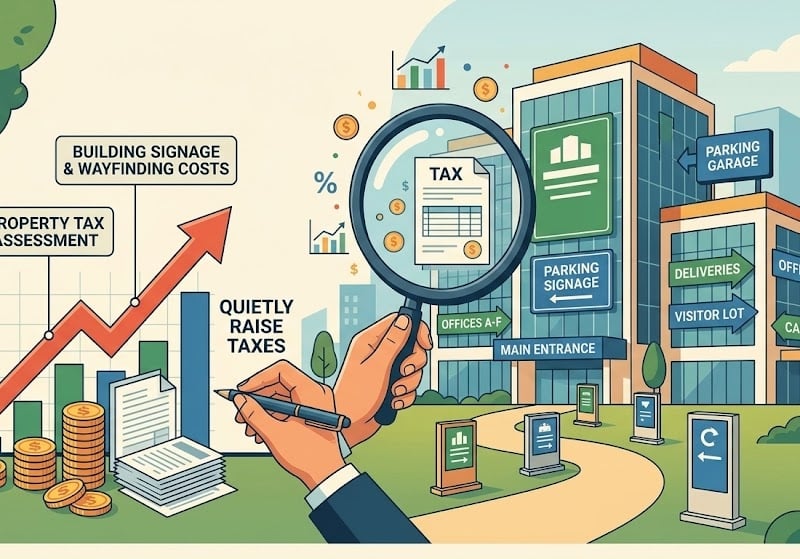
A district appraiser valued a tenant’s monument sign at $34,000. The sign cost $19,000 installed. Nobody at the ownership company caught it for two years, and the appeal window closed both times.
That gap is the whole story. Signage, fascia lettering, wayfinding hardware, and the lighting that makes them readable all get folded into your assessed value, and most owners never see the line item because it hides inside a category called “site improvements.” You pay for it every year, not once.
Here’s what I’ll cover: why signage lands in your valuation at all, which pieces genuinely belong there, which ones you can argue off, and the exact records to pull before your next protest deadline. If you own a restaurant, a clinic, a warehouse campus, or a strip center in Texas, this applies to you directly.
Why would a sign end up in your assessed value?
Because in most state appraisal systems, real valuation of property is built from replacement cost, market sales, and income, and replacement cost accounting sweeps in anything attached to the land. That includes your monument sign, your pylon, your canopy fascia, and sometimes a leased billboard structure you don’t even own.
The attachment test sounds simple: is it permanently affixed to the realty? In practice, appraisers and owners disagree all the time. A freestanding sign on its own foundation reads as real property. A channel-letter set bolted to a demountable panel reads as trade fixtures in a lot of jurisdictions. The distinction is worth real money, because trade fixtures typically fall under business personal property, which follows a completely different depreciation schedule than the building.
According to the Appraisal Institute, cost approach valuation rests on replacement cost new minus depreciation plus land value, which is why anything an appraiser treats as permanent gets depreciated on the building’s timeline rather than the sign’s much shorter economic life. A sign has a useful life closer to a commercial kitchen hood than a concrete tilt wall.
I stopped treating signage as a rounding error years ago. On a mid-size retail portfolio the difference between capitalizing sign value at building rates and at equipment rates is real, recurring money.
The items appraisers actually notice
Most owners picture a single sign. In practice, several buckets get rolled in, and you should know which ones you’re paying for before you argue about any of them.
- Monument and pylon signs with their footings, conduit, and electrical runs
- Building-mounted channel letters, backlit cabinets, and neon
- Property identification signage at entries, gates, and parking structures
- Exterior lighting installed specifically to illuminate signage
- Wayfinding and directory systems, including interior code signage in some counties
- Canopy and fascia modifications made to accommodate lettering
Two of those are usually defensible as personal property. Four are usually not. Knowing which is which saves you from a protest that gets denied on the first pass and burns your credibility with the appraisal district.
Where the numbers go wrong, and a habit that catches it
Appraisal districts don’t measure your sign. They estimate it from permit records, aerial imagery, and cost tables, then apply a depreciation curve that assumes a far longer life than any sign company would quote you. Fewer than four in ten owners ever look at that math before paying.
So here’s a habit worth building, and it’s the one I’d run if this were my own building. I call it the Sign Ledger, and it takes about two hours once a year.
- Photograph every sign on the property, including the ones you forgot about.
- Pull the original invoice or the sign company’s work order for each one.
- List installation date, total cost, and expected service life next to each photo.
- Compare that list against whatever line items appear in your notice or your rendition.
- Flag anything assessed above invoice cost, or depreciated slower than its service life.
Every year a building owner lets a sign sit on a depreciated-to-almost-nothing schedule while paying tax on it at near-full value, they’re handing money to the county. That’s the compounding part almost nobody talks about.
A district also can’t value what it can’t see, which cuts both ways. If you replaced a monument sign after storm damage and never rendered it, expect a surprise bump when aerial imagery updates. If you demolished one and the value didn’t drop, you have a clean argument sitting there unused.
Signage is only one line, and it’s rarely the biggest one
Here’s the honest framing. For most commercial owners, signage is a slice of the pie. Parking ratio adjustments, functional obsolescence from a dated floor plan, and cap rate selection on the income approach move far more dollars. Signage is the part you can verify with a two-year-old invoice, which makes it the easiest place to start learning how your assessment was assembled.
Once you understand how one cost line got built, the rest of the notice gets less mysterious. You start asking which comparable sales the district used, whether the rent roll it applied actually matches yours, and whether the vacancy factor reflects the market you operate in.
You also learn which fights aren’t worth having. Arguing about a $6,000 sign on a $9 million industrial building wastes everyone’s time. Arguing about it on 40 buildings across three counties is a different conversation entirely. Scale changes the math on everything.
That’s usually the point where owners bring in help. Assembling a defensible record means pulling invoices, reading cost schedules, hitting protest deadlines that vary by county, and sometimes taking a case to arbitration or district court. That work falls inside the standard scope of property tax advisors, who handle commercial and residential appeals across Texas and file business personal property returns nationwide. Whether you hire someone or do it yourself, the underlying discipline is the same: document what you own, what it cost, and what it’s worth now.
What changed in the sign industry, and why it matters to your file
Modern signage has shifted toward LED illumination, digital displays, and modular systems that arrive pre-assembled and bolt on in a day. Those products carry shorter service lives and higher obsolescence than the painted steel and neon they replaced, which means an appraisal district using an old cost table is almost certainly overstating their remaining value.
Underwriters Laboratories maintains published safety standards for electric signs and sign accessories, which sign fabricators follow when they build and label your product. That matters for your appeal because a labeled, modern, prefabricated sign is documented equipment with a known production date and a known cost. Standards bodies like UL give you a paper trail, and a paper trail beats an estimate every time.
Depreciation, though, is where the real dollars sit. A digital display bought three years ago has already lost a meaningful share of its value, and the county’s cost tables rarely keep up with that.
How to file your signage objection
Texas protest deadlines land in May for most jurisdictions, and the notice you receive will state the exact date. Miss it and you’re negotiating from behind for another year.
When you do file, attach the invoice, the installation date, and a photo set. State plainly which items you believe are personal property, cite the numbers, and ask for the corrected value. Appraisal districts respond to documentation, not to frustration. Every time a district has granted a reduction on one of my sign objections, the winning argument was a photographed invoice, not a rhetorical flourish.
And keep the file after you win. Next year’s notice arrives with the same inflated starting number, and the fastest way to fix it is a folder you already built.
Because here’s what makes this different from other tax fights: signage is one of the few lines on your assessment where the receipt in your hand can beat the county’s estimate outright. The only question is whether you pull it out this month or pay on it for another season.