
How Fog Wallpaper Adds Depth to Small and Narrow Rooms
Some rooms feel cramped no matter what you do. You move the furniture, try lighter paint, but the hallway still feels like a tunnel. A compact bedroom can have the same problem, with its walls seeming too close together.
Fog blurs where a landscape ends. On a wall, that hazy effect makes the space appear to continue beyond the room itself. For apartment dwellers and anyone dealing with awkward proportions, foggy wallpaper introduces depth without changing the layout. The fading details are central to how fog wallpaper creates depth in a room, making the illusion feel convincing rather than simply decorative.
Why Small and Narrow Rooms Feel So Confined
In a narrow hallway, both side walls and the end wall are visible at once. The boundaries are obvious, especially without natural light.
Compact bedrooms have a similar issue. With a bed occupying much of the floor, there’s little visible wall space left. Strong patterns and bulky furniture make the room feel even more crowded.
Light paint brightens a room but leaves its boundaries clearly defined. A scenic mural gives your eyes something to look into rather than a solid surface to stop at.
How Fog Creates the Illusion of Distance
Fog softens details as they recede into the background. That gradual change makes a flat image appear deeper.
Soft Gradients That Dissolve the Wall’s Edge
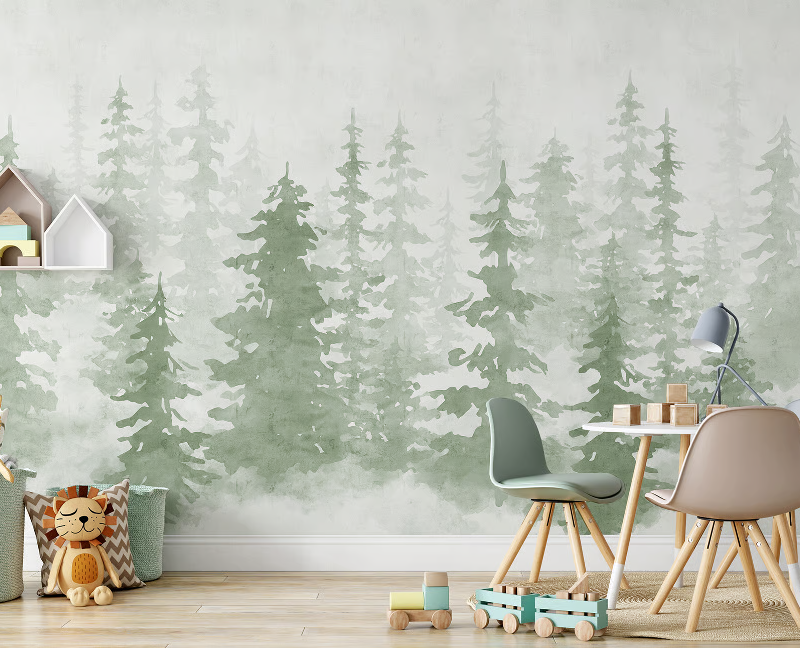
In a misty forest mural, dark tree trunks gradually fade into pale gray fog. Your eye follows the shapes into the lighter area without finding a clear endpoint.
A pale upper section can also blend with a light ceiling, making the boundary between the two surfaces less noticeable.
Avoid designs with a large black foreground if the room is especially small. Heavy contrast draws attention to the wall itself instead of the distant scenery.
Atmospheric Perspective and Why the Eye Reads It as Depth
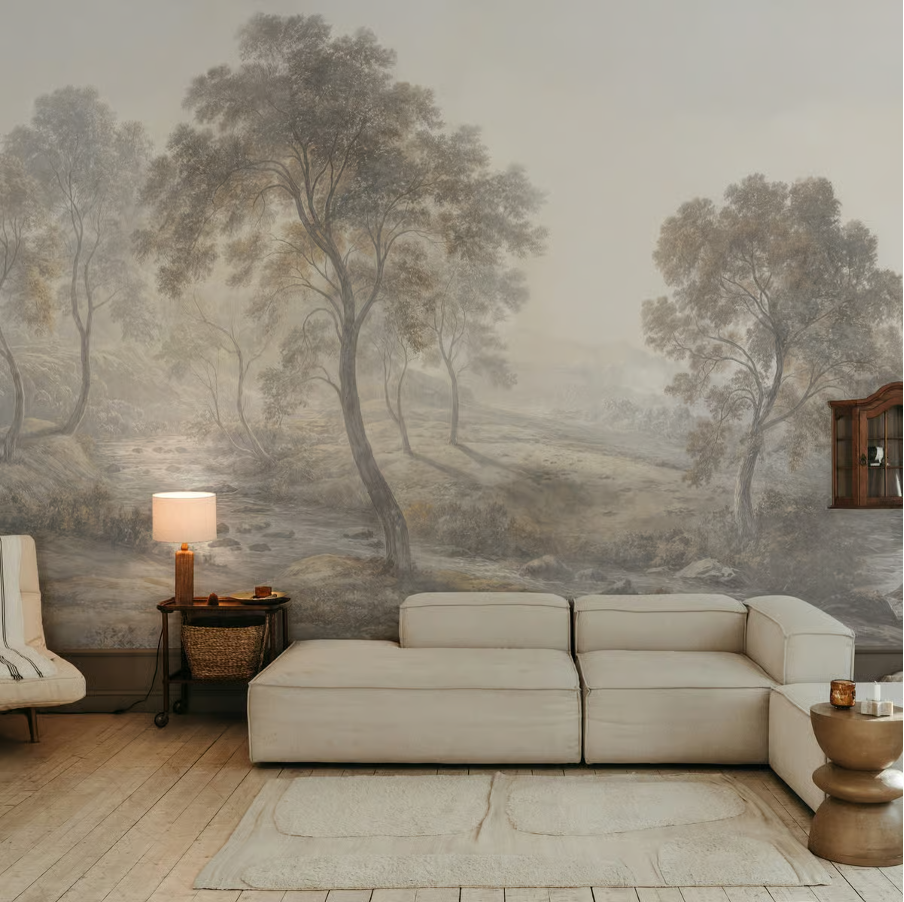
On a foggy morning, nearby trees appear darker and more detailed. Hills farther away lose their sharp outlines and fade into lighter shades.
Artists call this atmospheric perspective. We recognize fading details as signs of distance, even in a flat image.
A mural with several layers of misty mountains uses that effect. Your eyes move toward the faint peaks in the background, creating the impression of space beyond the wall.
Where to Place Fog Wallpaper in Narrow Rooms
The right wall depends on the room’s proportions and the direction you want the eye to travel.
- Long hallway: Choose a softly fading landscape for the end wall. Fog wallpaper for narrow hallway spaces works well when the distant scenery has no strong lines pulling the eye farther down the corridor.
- Very narrow corridor: A misty forest on one side wall helps soften the space. Avoid a sharply defined path on the end wall if the hallway already feels excessively long.
- Small bedroom: The wall behind the headboard offers a relatively clear surface. A low headboard keeps more of the landscape visible.
- Boxy spare room: Try a mural opposite the entrance, away from wardrobes or shelving that would hide the scene.
One well-chosen wall is enough. Extending a detailed landscape around several corners risks breaking up its perspective.
Choosing the Right Fog Design for Your Room’s Size and Light
A sunny bedroom and a windowless corridor need different designs.
For misty wallpaper for small rooms, look for pale backgrounds and gentle transitions. Soft sage forests and distant gray mountains provide detail without covering the wall in dark shapes.
In a room with little daylight, choose a scene with enough light areas to keep the landscape visible. Heavy shadows tend to look gloomy under weak artificial lighting.
Think about the room’s proportions too. Tall trees emphasize height, which suits a low ceiling. In a narrow room, horizontal layers of distant hills help draw attention across the wall and make it appear wider.
When comparing wallpaper for narrow rooms, check the full composition. A tree that looks delicate in a product photo might dominate the wall once enlarged.
Furniture, Color, and Lighting That Support the Effect
Furniture should leave enough of the landscape visible. A tall, dark wardrobe beside the mural creates a hard boundary that works against the misty effect.
Try carrying one of the wallpaper’s quieter colors onto an adjacent wall. A pale gray-green forest works with warm oak furniture and off-white paint without everything looking overly matched.
Lighting matters in windowless hallways. Several evenly spaced fixtures distribute light more evenly than one bright bulb. A strong spotlight aimed at a small section of the mural makes the gradient look patchy.
If light reflects directly onto the wall, consider a matte finish. Glare draws attention to the wallpaper’s surface and weakens the illusion.
Mistakes That Flatten the Illusion
Even a beautiful landscape can disappoint if the design doesn’t suit the space.
- Large black shapes in the foreground draw attention away from the distant mist and make a compact room feel heavier.
- A uniform cloudy pattern creates atmosphere, but without distinct layers, there’s little to suggest distance.
- Cropping away the pale background removes the part of the landscape that gives the mural its depth.
- Don’t position a wide cabinet across the main scene. It interrupts the visual path into the landscape.
- Strongly contrasting colors on adjacent walls make the mural’s edges more obvious, especially at the corners.
Before ordering, check the final crop and how the colors appear under your usual lighting. A scene that looks beautifully misty in daylight shouldn’t turn into a flat gray patch under your hallway lamps.
Conclusion
A narrow hallway doesn’t necessarily need another mirror or a furniture makeover. A softly fading landscape on the right wall changes where your eye settles, making the end of the room feel less abrupt.
Fog wallpaper doesn’t fight a small room’s limits. It quietly softens them, making the walls feel less imposing and the room calmer, deeper, and more open than its measurements suggest.