
No Sign Up Image To 3D Pipelines For Digital Type Designers
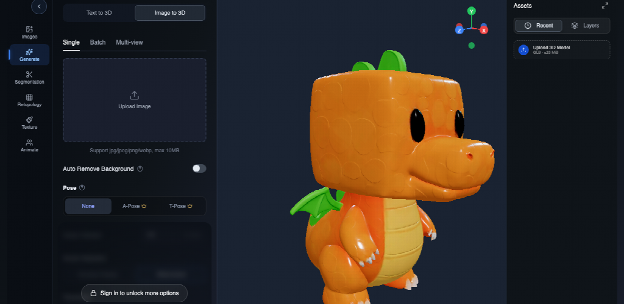
Type designers rarely know how flat display glyphs behave in physical space until someone models them. Using a fast No sign up image to 3D tool lets foundries test volumetric letterforms directly in the browser without installing heavy workstation software.
Traditional font editors excel at vector Bezier curves, but modern brand identities demand spatial interaction under physical lighting. Waiting days for external specialists to build test mockups stalls exploratory review rounds. Instant web-based generation closes that gap before teams commit to extended 3D production.
The Architectural Shift Toward Instant Web Mesh Generation
Earlier iterations of image-based 3D reconstruction relied on resource-heavy photogrammetry engines or complex server setups requiring credential authentication, software installation, and prolonged queue management. The development of streamlined platforms like ImageTo3D represents an architectural transition toward zero-friction creative exploration. Instead of forcing designers to navigate token licensing, enterprise seat assignments, or corporate credential gates, modern web engines process image inputs directly inside browser sessions using optimized cloud pipelines.
Direct Browser Execution Without Account Setup Friction
Eliminating registration and sign-in gates fundamentally changes how studio teams experiment during the exploratory phases of font development. Type foundries often test dozens of potential ligature weights, alternate glyph terminals, and punctuation swashes in rapid succession during creative pitches. Requiring team members to log into walled corporate portals for brief exploratory conversions frequently interrupts the organic rhythm of type evaluation.
When artists can drag an isolated letterform snapshot or vector export onto a clean canvas and receive watertight geometry in seconds, volumetric testing becomes an informal sanity check rather than a scheduled production ticket. Junior designers, art directors, and typographers can independently verify bevel behavior across hundreds of test characters without managing per-seat software entitlements. This instant feedback loop prevents unworkable glyph proportions from advancing into finalized branding proposals.
How Neural Networks Reconstruct Spatial Meshes From Flat Vector Renders
Translating a two-dimensional raster image or vector graphic into a fully realized 3D mesh requires intelligent spatial inference. Conventional extrusion tools simply push flat planar faces along a singular normal axis, creating uniform block structures with rigid orthogonal walls and sharp unnatural edges. In contrast, neural reconstruction architectures analyze boundary luminance gradients, edge contours, and tonal values to infer volumetric curvature and organic surface relief across the entire form.
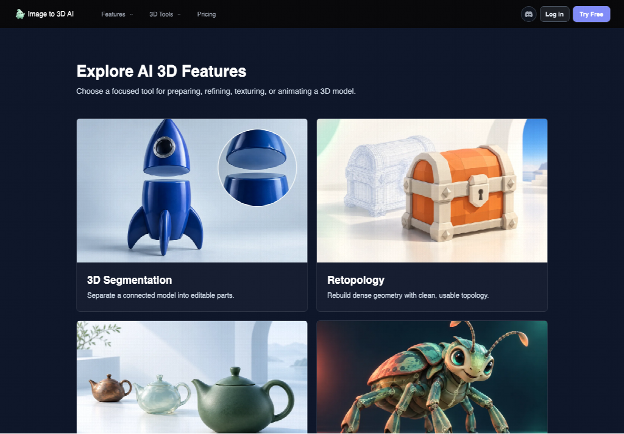
Single View Depth Estimation And Volumetric Inflation
When evaluating a single orthographic render of an intricate glyph, the underlying vision model calculates a continuous depth map across every pixel cluster. The system predicts front-facing curvature, corner bevel angles, and recessive cavities without requiring explicit stereoscopic references. Within the ImageTo3D pipeline, this automated volumetric inflation constructs continuous polygonal skins that honor the intended contrast between thick character stems and delicate hairline serifs.
If an input drawing exhibits ambiguous negative space, such as the enclosed counter of a lowercase italic glyph, conventional tools often generate non-manifold topological pinch points. Neural depth estimators predict plausible interior walls, ensuring the resulting geometry forms a cohesive closed shell rather than disconnected intersecting planes. This structural integrity ensures that even experimental high-contrast letterforms retain structural definition under aggressive directional lighting. In practical foundry workflows, the algorithm evaluates how acute inner vertices meet adjoining stem baselines, preserving clean mechanical transitions instead of creating pinched geometry. Typographers can adjust ambient occlusion thresholds on the fly to confirm that subtle optical traps do not collapse into solid blocks when the asset is rotated toward acute camera angles.
Multi View Alignment And Normal Map Synthesis
For more demanding custom letterforms where reverse-angle silhouette fidelity is mandatory, feeding multiple orthographic view angles provides deterministic spatial cues. The engine cross-references silhouette boundaries across frontal, side, and elevated angles to solve complex geometric depth puzzles. High-frequency micro-details that would otherwise balloon vertex density are synthesized into tangent-space normal maps.
This separation between structural base polygons and high-resolution normal textures ensures the resulting asset remains lightweight while reflecting fine surface nuances under studio spotlights. Graphic designers can inspect physical shadows cast by heavy slab serifs under multiple light sources within seconds of upload. Fine bevel treatments, micro-chiseled facets, and subtle surface grain can be inspected in real time without bogging down the viewport.
Export Standards Supporting Direct CAD And Motion Graphic Integration
A procedural 3D model is only as valuable as its downstream interoperability with industry-standard computer graphics software. Generating geometry in browser environments requires clean export paths into motion graphics suites, rendering engines, and additive manufacturing slicers without format corruption or missing texture bindings.
Modern browser mesh tools support immediate packaging into primary production formats:
- GLB Container Format: Encapsulates vertex coordinate buffers, index arrays, PBR material parameters, and baked texture channels into a compact binary package optimized for instant WebGL and AR display.
- Wavefront OBJ Format: Delivers clean quad and triangle vertex geometry alongside explicit UV mapping coordinates and associated material library files for direct editing in traditional DCC software.
- Stereolithography STL Format: Strips away color and surface texture channels to deliver pure surface tessellations specifically calibrated for 3D printing slicer software.
By producing clean exports across these three formats, ImageTo3D bridges the gap between digital screen design and physical architectural fabrication. Type designers can hand off identical spatial coordinates to web developers constructing interactive hero banners, game animators building volumetric title sequences, and industrial fabricators carving illuminated acrylic signage on multi-axis CNC mills.
Practical Clean Up Rules For Manifold Geometry And Topology
While automated mesh generation saves substantial modeling time, type designers must establish rigorous inspection criteria before releasing generative models to manufacturing pipelines. In our studio evaluation protocol, checking mesh integrity across five key metrics prevents costly downstream machining failures. When testing spatial letterforms, uninspected inverted face normals or non-manifold internal edges will cause slicing engines to fail or generate hollow structural cavities during physical 3D printing.
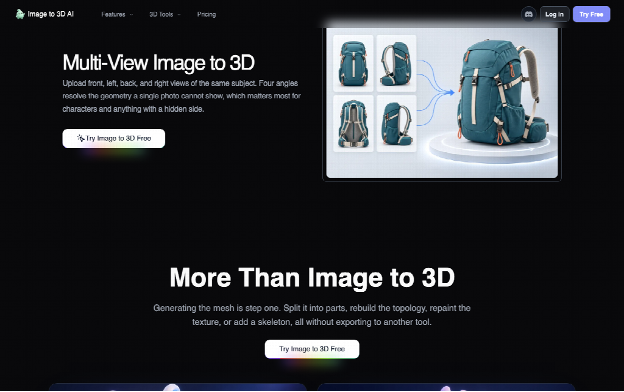
During a recent project review, inspecting raw unoptimized letterform meshes revealed that intricate script ligatures with overlapping terminals generated severe self-intersecting polygon clusters. Without automated retopology, manual retopology cleanup consumed nearly forty-five minutes of rework per character in desktop sculpting suites. Leveraging integrated AI retopology eliminates irregular polygon clusters, redistributing vertex density evenly across curved strokes while preserving sharp typographic apexes.
Reviewers should systematically reject meshes where thin hairline serifs drift below minimum wall thickness thresholds required for physical fabrication. Identifying these volumetric defects in the browser viewport prevents wasted production budget and material scrap in downstream workshops. Establishing a strict quality gate ensures that every exported glyph meets the structural standards required by industrial manufacturing.
Strategic Implementation Decisions For Digital Typography Studios
Incorporating rapid spatial prototyping into traditional type design studios does not require overhauling established vector drawing conventions. Rather than treating 3D conversion as a separate post-production phase handled by outside contractors, foundries can deploy browser mesh tools during initial concept development to validate letterform versatility across both print and immersive digital platforms.
Using ImageTo3D as an on-demand spatial sandbox enables independent foundries to pitch dynamic spatial branding concepts that previously required dedicated CGI contractors. Designers maintain absolute command over font aesthetics while expanding their deliverable portfolios into interactive web graphics, virtual exhibitions, and tangible signage. This streamlined approach minimizes technical overhead while expanding commercial value.
Adopting friction-free web tools allows typographic craftsmen to explore three-dimensional space with the same agility they bring to two-dimensional vector curves, unlocking new commercial possibilities for modern letterform design.