
Open Source, Open Threat: What Happens When Fingerprinting Tools Become Freely Available
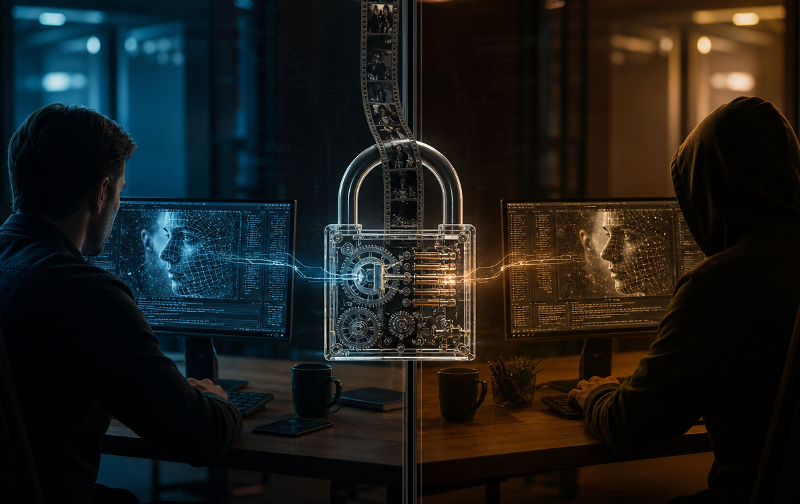
A decade ago, the software that could recognize a pirated film belonged to a short list of vendors. Building a rival took specialist engineers, licensing deals and a reference library no start-up could assemble. Today a hobbyist can install a free package with one line typed into a terminal, point it at two video files and get back a number describing how alike they are. The code is public, the documentation is thorough, and the tutorials are one search away.
That change helps anyone who needs to find copies of a video, and the people who need that most are rights holders, independent publishers and the moderation teams at platforms too small to afford an enterprise contract. It also helps anyone who wants to avoid being found. Video fingerprinting has become a field where one repository can serve a studio’s anti-piracy unit and an uploader testing an edit in private, using identical code. What follows looks at how that overlap works, where the danger is real and where it tends to be exaggerated.
A Toolbox Anyone Can Download
The basic idea is easy to explain. A perceptual hash is a short numeric summary of what a piece of media looks like. Ordinary cryptographic hashes behave like a paper shredder: change one bit of a file and the output becomes unrecognizable. A perceptual hash is built to do the opposite, so two clips that look alike to a person produce summaries that sit close together.
Several mature implementations are free. The pHash library, written in C++ and released under the GPL, has been a reference point for years. Videohash, a Python package, boils a whole clip down to a 64-bit value and can fetch a video straight from a web link, as long as FFmpeg is installed. The largest contribution comes from Meta. Its ThreatExchange repository bundles PDQ, a 256-bit image hash built on a discrete cosine transform, with two video methods. One, vPDQ, judges similarity by counting shared frames. The other, TMK+PDQF, produces signatures of 256 kilobytes per video. The same repository includes a ready-made moderation platform, client libraries in four programming languages, and a version that computes hashes inside an ordinary web browser.
For anyone who needs to fingerprint video on a shoestring, that is a starting kit. A one-person forum can now run duplicate detection that once required a large platform’s engineering team.
Built for Defense, and Better for It
Meta’s stated purpose was moderation. Once a reviewer decides that a piece of content breaks the rules, matching software can apply the same decision to every later copy. The company then ran a public contest: about 100,000 videos drawn from a public research collection, with edited copies produced in part by an augmentation toolkit. Entrants had to work out which clips were derived from which originals and locate the copied stretch inside longer footage. The best entries beat the starting baseline by more than 40 percent on one task and more than 105 percent on the other. Every prize-winning solution was released under an open license.
One finding stands out. The winners mostly used ordinary image models applied to sampled frames, rather than purpose-built video models. That makes state-of-the-art copy detection far easier to reproduce than a specialized video system would be, and it explains why the technique spread so fast.
The Same Code, the Opposite Intent
For a rights holder, a matcher is a net. For an uploader, it is a mirror. The difference lies in what each side does with the score. Until recently, anyone trying to slip a copy past a platform’s filter was testing in public. Every attempt meant uploading to the real system, and every failure risked a claim, a strike or a banned account. With an open implementation on a laptop, the loop of edit, measure and adjust is free and invisible. The pirate rehearses at home and goes live only with a version that already scores low.
Two cautions keep this from becoming a doomsday story. First, the public algorithms are not the ones inside the big commercial and platform systems, which typically combine several signals and keep their thresholds private. Fooling a free library says little about fooling a production system. Second, open tools are candid about their limits. The Videohash documentation itself warns that the package cannot tell whether one clip is a fragment of another and stumbles when footage is substantially altered. Hobby-grade software fails in ways any engineer could predict.
Still, the blind spots of a category are shared across implementations, and reading how a hash is built is a lesson in what it ignores. That is the real cost of openness: not a ready-made bypass, but a clear view of how the measuring stick works.
What Researchers Found When They Attacked the Tools
Academic security teams have been probing these functions for years. Papers have demonstrated evasion against PDQ and pHash under white-box conditions, where the attacker sees the algorithm’s internals, and under black-box conditions, where only inputs and outputs are visible. NeuralHash, Apple’s perceptual hash, was attacked too, with prototype code. A second kind of attack, the collision, runs the other way: it makes an unrelated image produce the same hash as a chosen target. The two failures matter differently. An evasion produces a false negative, a copy that slips through. A collision produces a false positive, an innocent file accused.
NeuralHash is the best-known case. Apple proposed using it to scan photos on devices for known abuse imagery. After researchers extracted the model from iOS, collisions appeared within days. Critics warned that if the hashes on a target list ever leaked, someone could craft harmless-looking images that trigger matches, or bury human reviewers under false alarms. Apple eventually shelved the plan. In a copyright setting, the equivalent worry would be a crafted file that makes a rival’s legitimate video look like someone else’s property.
The picture is not uniformly bleak. A 2024 workshop paper presented at NeurIPS tested PhotoDNA, PDQ and NeuralHash against black-box evasion, with realistic limits on how much an image may be altered and how many times the system may be queried. It found them considerably sturdier than earlier work suggested. Its authors proposed mixing deliberate randomness into hash values as a countermeasure. A separate academic study comparing six hash functions found NeuralHash far more exposed to near-collisions than pHash-256 or PDQ under the methods tested. Nearly all of this research concerns still images, but most video matchers are built from frame-level image hashes, so the findings carry over.
Open Does Not Mean Equal
The matching function is only one piece of a working system. Industrial setups pair visual analysis with audio and motion signals. They check candidates in two stages, hold reference libraries covering millions of registered works, and crawl dozens of platforms at once. A single video fingerprint is cheap to compute. Fingerprinting video at the scale of a major platform, in real time, against a database that changes every hour, is another job entirely.
Defenders also learn from offense. Winners of the earlier image-matching contest credited training on aggressively edited samples, along with explicit detection of overlays pasted onto footage. In other words, they simulate the edits people actually make and teach models to see through them. Every trick that gets documented in public becomes a line in someone’s training script.
For buyers hunting for the best video fingerprinting software, the open-source wave changes the checklist. The matching algorithm is turning into a commodity a developer can download over lunch. What still separates one vendor from another is everything around it: how large and current the reference library is, whether the system can watch a live stream rather than only uploads, how fast a match becomes a takedown, and whether the evidence holds up when the other side’s lawyers start asking questions.
The Case for Leaving Everything Public
Security engineers have long argued that a system which only works while its design stays hidden is a system waiting to fail. The NeuralHash episode fits that view. Its flaws surfaced in public, within days, before the scheme reached a single user. A closed matcher’s weaknesses get found as well, but privately, by people with no reason to report them.
Openness also helps in court. A matcher whose code anyone can run is one whose error rate anyone can measure, which is exactly what judges ask for when a match report lands on the evidence table. Vendors who treat the algorithm as a trade secret have a harder time answering the plain question of how often they are wrong.
Against that stands a practical worry. Nobody publishes the blueprints of a vault on purpose. The honest answer depends on what is being protected. A perceptual hash has no secret key. Whatever secrecy exists lives in the surroundings: the reference list, the thresholds, the mix of signals and any randomness added on top. Forensic watermarking works differently. It embeds an identifier that is extracted with private keys, so it does not depend on matching a public function at all. That is why serious anti-piracy programs rarely rely on a single technique.
A Lock Built in the Open
Cryptographers settled a version of this argument long ago: a lock worth trusting is one whose design can be published without weakening it. Fingerprinting has not reached that point, because a perceptual hash has no key to hide. The function is the whole mechanism.
The likely outcome is a split. The commodity layer will be public, tested in the open and available to everyone from a hobby forum to a major studio. The decisive layer will stay private: reference libraries, tuned thresholds, stacked signals, watermarks and the speed of the human team that follows up on a match. Open source will not end the contest between rights holders and infringers. It means both sides now run their experiments with the same tools, and the advantage goes to whoever has better data, sharper judgment and a faster response.