
Building AI-Powered Design Tools: Key Features and Technologies
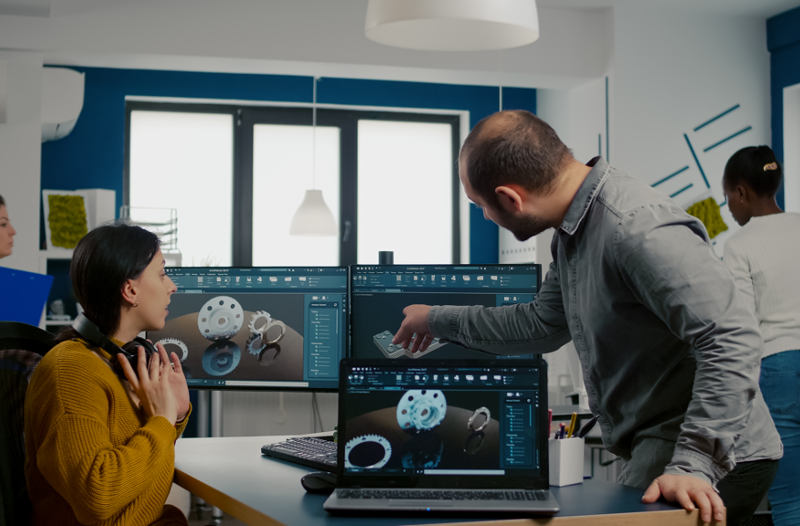
How designers interact with design software has changed over the years. Now, clients want software that doesn’t just provide them with a blank canvas and editing tools, but assists them in speeding up their usual processes and giving them ideas, and also simplifies what was difficult at first without interrupting the process of creation.
This is how AI tools for design have become popular. Programs such as Figma, Adobe Firefly, Canva, and some emerging start-ups have demonstrated that AI is no longer a good portion of a roadmap to work with. Well incorporated, AI becomes an integral part of the process itself.
Therefore, companies that want to create the next generation of design software have to think not only about the inclusion of an AI model. The main challenge is to come up with a method to integrate different functions, technologies, and user experiences into a product that designers will be interested in, and that’s why they invest in SaaS development services and often plan these AI capabilities from day one because adding them later usually requires significant architectural changes.
AI Should Support Creativity, Not Replace It
Before addressing technology or features, there is one thing that every product team needs to decide: what is the purpose of incorporating AI into the design? The objective is not to create software that does all of the jobs by itself. It is about creating tools that help avoid monotonous work while still allowing users to be in charge of creativity. This is why many companies rely on an experienced AI development company in the planning phase, confirming that AI would be integrated into the product in a helpful way, rather than in an intrusive one.
If you think of all those tasks that designers do daily, such as removing backgrounds, scaling textures to different platforms, finding suitable font sets, sorting files, or preparing different versions of layouts, it becomes evident that these are noncreative, time-consuming tasks.
Features That Add Real Value
Including every current AI feature in a product might appear appealing. Yet the fact on the ground is that the most beneficial user experience is provided by a limited number of features rather than many useless AI features.
These features have been commonly used in several successful AI-powered design solutions.
| Feature | Why It Matters |
| Text-to-image generation | Helps users visualize concepts and create illustrations from simple prompts. |
| Smart layout suggestions | Recommends spacing, alignment, and composition improvements automatically. |
| AI typography recommendations | Suggests font pairings based on design style, readability, and branding. |
| Background and object removal | Eliminates time-consuming manual editing with a single action. |
| Color palette generation | Creates balanced palettes from prompts, images, or brand guidelines. |
| AI-powered asset search | Lets users find icons, illustrations, and templates using natural language instead of keywords. |
| Accessibility recommendations | Detects low contrast, readability issues, and other accessibility concerns before designs are published. |
| Responsive design adaptation | Automatically adjusts layouts for desktop, tablet, and mobile screens. |
| Version and variation generation | Produces multiple design alternatives without recreating layouts from scratch. |
Note that most of these features do not replace designers because what they do is minimize obstacles rather than automating the process of creation.
The Technology Behind AI Design Platforms
A good user experience is always built on a good technological background. Even though the user interface is quite simple, there are many technologies that work together to ensure the efficiency of the work performed by the tool.
| Technology | Purpose |
| Large Language Models (LLMs) | Understand prompts, generate copy, explain design decisions, and assist users conversationally. |
| Diffusion Models | Generate original images, illustrations, icons, and creative assets from text prompts. |
| Computer Vision | Enables object detection, image segmentation, background removal, and smart editing features. |
| Vector Databases | Improve semantic search for design assets, templates, and previously created projects. |
| Cloud GPU Infrastructure | Processes computationally intensive AI tasks while maintaining responsive performance. |
| Real-time Collaboration Frameworks | Allow multiple designers to edit and review projects simultaneously without conflicts. |
| AI APIs and Model Integrations | Connect the application with external AI models, image generation services, and specialized tools. |
| Analytics and Feedback Systems | Learn from user behavior to improve recommendations and personalize future experiences. |
In addition, the choice of the necessary technologies is not only based on the technical aspects. It impacts some factors, like performance or infrastructure investment costs, among others.
That is why a lot of companies cooperate with a trustworthy AI development service provider before the development begins.
Challenges Product Teams Should Expect
An AI-supported design platform presents a range of challenges that go beyond mere software engineering.
1. Among the prominent issues is the response time. Users expect interactions to take place in real-time, no matter if a designer is using the AI to generate images or to analyze the complex design. Slow system response slows down the creative process.
2. Cost is also important. Generating images and using sophisticated AI systems requires a lot of computing power, and planning for infrastructure to accommodate products for scaling is crucial.
3. And then there’s consistency. AI results should be dependable enough for users to trust them, but at the same time flexible enough to allow for creativity. If by any chance the suggestions seem incoherent or arbitrary, people will not be willing to use them.
4. The subject of confidentiality, copyright, and AI securityshould also be stressed. Many businesses worry that their designs and other materials might be used for training AI publicly or leaked.
Addressing these concerns provides a positive tandem for users to start using the technology.
Building Products Designers Want to Return To
The most effective design tools powered by AI are not successful because of their powerful algorithms. Instead, they are successful because they blend well with the processes already in place.
Designers still want control in making every key decision. The aim for AI should always be to assist, speed up, and facilitate, but never to determine the flow of creativity.
This means that each suggestion must always be easy to modify, created assets must always be changeable, and actions performed by the AI must always be expected rather than surprising.
When AI becomes a reliable creative partner instead of an unpredictable feature, users are more likely to include it in their regular workflow.
Conclusion
Developments in design technology because of AI have great potential; however, the real potential does not lie in adding more AI features but in developing new products allowing designers to move efficiently from concepts to execution.
The companies that stand out in this space will be the ones that combine practical AI capabilities with thoughtful product design, scalable technology, and a deep understanding of how creative professionals actually work. If all these elements are put together, the AI will be able to become more than a fashion device and instead become a must-have feature.
About the Author:

Sanjay Singh Rajpurohit is the Founder & CEO of Technource, a product engineering company with over 13 years of experience helping startups and businesses design, build, and scale digital platforms, SaaS systems, and AI-powered workflow automation solutions. He works closely with clients to define product strategy, identify scalable architecture, and guide organizations through product engineering, MVP development, and platform modernization initiatives.
His expertise lies in translating business ideas into structured digital solutions, including marketplace platforms, business systems, and custom SaaS applications. Sanjay frequently writes about product engineering strategy, build vs buy decisions, platform scalability, and technology planning for startups and growing businesses.
He also contributes insights on digital transformation, AI-driven automation, and platform-based architecture, helping organizations move from concept to scalable product ecosystems.