
How I Find High-Converting Ad Hooks Using Ads Library (With Real-World Experience)

After more than a decade working with paid ads, I’ve learned one lesson the hard (and expensive) way:
Ad hooks make or break campaigns.
You can have the cleanest funnel, the best landing page, and a generous budget—but if the hook fails in the first few seconds, nothing else matters. Early in my career, I spent far too much time testing hooks blindly. I relied on instinct, creativity, and what felt compelling.
That changed the moment I started using Ads Library properly.
Not casually.
Not for inspiration.
But as a systematic hook research tool.
This article is a personal account of how I use Ads Library to consistently uncover high-converting hooks—and how this approach has saved me time, budget, and frustration across multiple industries.
The Real Problem With Hooks (And Why Most Fail)
Most people think hooks are about clever words or flashy visuals. That belief leads to endless brainstorming sessions and creative burnout.
In reality, hooks are about attention plus relevance.
Early on, I made the mistake of inventing hooks in isolation—without validating whether the market already responded to similar messages. Unsurprisingly, many of those hooks failed. What Ads Library taught me is that the market is already telling you what works—you just need to listen.
How I Stopped Guessing and Started Observing
The turning point came when I reframed how I used Ads Library.
Instead of asking:
“What hooks should I try?”
I started asking:
“Which hooks are already working right now?”
Ads Library doesn’t show performance metrics, but it shows something just as valuable: persistence.
If a hook keeps appearing across multiple ads, formats, and weeks, it’s not there by accident.
That insight changed my entire creative process.
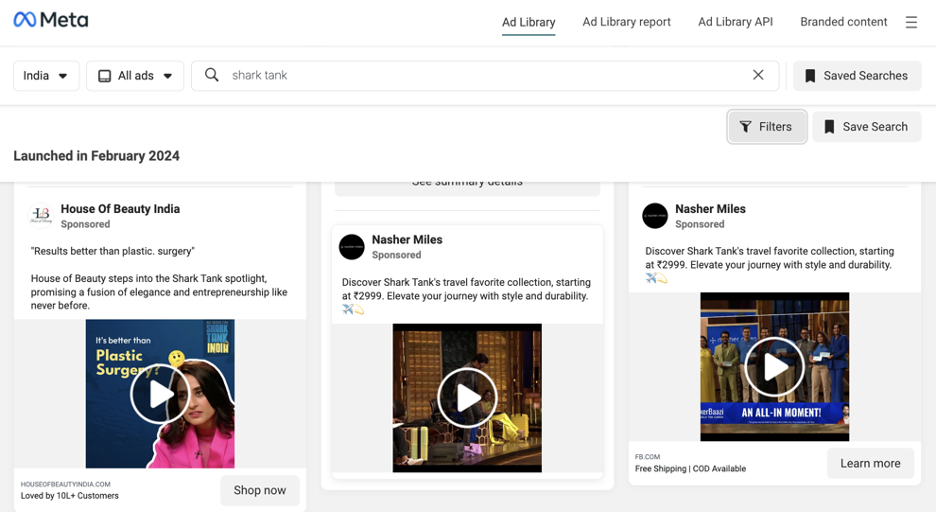
Step 1: I Ignore Most Ads on Purpose
This might sound counterintuitive, but when I open Ads Library, I deliberately ignore:
- Brand-new ads
- Highly stylised one-offs
- Anything that looks like a test
I focus only on ads that show signs of survival.
In my experience, long-running ads are the closest thing Ads Library offers to proof of conversion. Hooks that last are hooks that pay for themselves.

Step 2: I Track Hook Repetition, Not Cleverness
One of the biggest mistakes I used to make was chasing clever hooks. Ads Library helped me unlearn that habit.
What I look for now:
- Similar opening lines repeated across different ads
- The same pain point framed in multiple ways
- Identical promises expressed with slight variations
When I see repetition, I take notice.
For example, if multiple competitors open with:
- “Still struggling with…”
- “Most people don’t realise…”
- “If you’re tired of…”
I don’t copy the words—I identify the underlying angle.
That angle becomes the foundation of my own hooks.
Step 3: I Classify Hooks by Emotional Trigger
Over time, I noticed that winning hooks usually fall into a few emotional categories.
Using Ads Library, I now categorise hooks into:
- Pain avoidance (fear, frustration, inefficiency)
- Desire amplification (status, growth, confidence)
- Curiosity gaps (“This is why…”, “You’re doing this wrong…”)
- Relief and simplicity (“Finally…”, “The easiest way…”)
When I see the same emotional trigger repeated across advertisers, I know it resonates deeply with that audience.
This makes hook creation faster and more intentional.
Step 4: I Watch How Hooks Evolve Over Time
One of the most underrated benefits of Ads Library is historical context.
By revisiting the same advertisers regularly, I can see:
- Which hooks disappear quickly
- Which hooks evolve but remain conceptually the same
- Which hooks get reinforced during promotions or scaling
In one campaign I worked on, I noticed a competitor gradually shortening their hooks over several months—same idea, fewer words. That suggested optimisation, not experimentation.
I mirrored the principle—clarity over cleverness—and saw immediate performance improvements.
Step 5: I Validate Hooks Before Writing a Single Word
Before Ads Library, I would write 10–15 hooks and test them live.
Now, I validate before writing.
If I can find:
- 3–5 advertisers using similar hooks
- Hooks running longer than a few weeks
- Multiple creative formats supporting the same idea
I know I’m starting from a position of strength.
Sometimes I support this research using tools like adslibrary.to, which helps streamline ad discovery when analysing multiple competitors quickly. Used sparingly, it saves time—but the thinking still matters more than the tool.
What Ads Library Taught Me About “Original” Hooks
One uncomfortable truth Ads Library revealed is this:
Most high-converting hooks are not original.
They are refined.
They’ve been tested, validated, reworded, and reinforced by the market over time. Originality in advertising doesn’t come from inventing new pain points—it comes from expressing existing ones more clearly.
Once I accepted that, my hook performance improved dramatically.
Why Beginners Struggle With Hooks (And I Did Too)
Looking back, my early hook failures weren’t due to lack of creativity. They were due to lack of context.
Beginners (my past self included) often:
- Write hooks in isolation
- Fall in love with clever phrasing
- Ignore what the market already responds to
Ads Library forces discipline. It replaces ego with evidence.
That shift—from “What do I like?” to “What does the market respond to?”—is where consistency comes from.
Hooks Are Signals, Not Headlines
Another lesson Ads Library taught me is that hooks are signals, not slogans.
A strong hook signals:
- Relevance
- Understanding
- Immediate value
When hooks align with validated market signals, performance becomes predictable—not random.
That predictability is what allows campaigns to scale.
Using Ads Library in a Privacy-First Advertising World
As tracking becomes less precise and attribution less reliable, Ads Library has become even more important in my workflow.
It doesn’t rely on pixels or reports.
It relies on observable advertiser behaviour.
Whether accessed directly or supplemented with platforms like adslibrary.to, the real advantage comes from pattern recognition, not shortcuts.
Final Reflection: Hooks Stop Being Hard When You Stop Guessing
Finding high-converting hooks used to feel like guesswork.
Now it feels like research.
Ads Library didn’t make me more creative—it made me more accurate. Instead of chasing ideas, I follow evidence. Instead of guessing, I observe.
And once you start doing that, hooks stop being a gamble and start becoming a repeatable system.
That’s the real power of Ads Library—and why I still use it before writing a single hook today.