
8 Digital Marketing Tools That Earn Visibility in AI Answers (2026 Field Guide)

In the second quarter of 2025, a mid-market client’s highest-traffic guide stopped behaving. Same rankings, same content, but the organic sessions it had fed for two years slid week over week. When we pulled the query set apart, the pattern was plain: an AI summary now sat above the results for most of those searches, and the click never reached the page. The tool that flagged the drop could not tell us why it happened. That gap is what this piece is about. If you run digital marketing tools for an agency or an in-house team, the question has shifted from where you rank to whether you show up in the answer at all. In March 2025, 18% of all Google searches produced an AI summary (analysis of 68,879 real searches). This guide covers eight digital marketing tools we track across client accounts, judged on one thing: whether they help you appear in AI answers and measure what happens when you do.
Why AI Visibility Now Decides Which Marketing Tools Earn Their Place
When an AI summary appears on a Google search, users click a traditional result only 8% of the time, versus 15% when no summary shows. The click you optimized for is being absorbed into the answer. That is why a marketing stack is now measured on AI-answer presence, not rank alone.
What we’re seeing across accounts: the shift is not coming, it is here and it is measurable. SE Ranking’s 2025 research found that 68.94% of sites now receive some AI-driven traffic, roughly eight times the year before. That traffic arrives from a surface most reporting tools were never built to read.
The consequence for a marketing stack is direct. For years the job of your digital marketing platforms was to win a position and count the click that followed. Both halves of that model are moving. Position still matters, but it no longer guarantees the click, and the click increasingly happens inside an answer you cannot see in a rank report.
So the test for every digital marketing tool changes. Not only “can this help me rank,” but: can it tell me whether I appear in AI answers, across which engines and prompts, and measure what that presence is worth. A tool that tracks positions alone now reports on half the board. The digital marketing tools below earn their place by covering the other half, or by feeding the content and signals that get you into the answer.
How We Judged These Tools
We judged these eight digital marketing tools against six criteria, all bent toward one question: does the tool give you a usable AI-search signal you can check on a fixed cadence. Feature depth and price mattered less than whether a reading tells you what to do next.
- A real AI-search signal: does it report presence in AI answers, not just organic rank
- Measurement honesty: does it show where its data ends, so you know what you cannot yet see
- Weekly cadence: can you check it on a fixed schedule without a manual export every time
- Coverage: how many answer surfaces or marketing channels it reads
- Actionable data: does a reading point to a next move, not just a number
- Scale: does it hold up across multiple accounts or a full in-house stack
The method behind these picks is the one we run on retainers: each tool tracked across eleven client accounts, checked weekly since January 2025, with every reading compared to our manual answer-layer checks. Nobody has years of data on this yet, including us. This is what disciplined tracking supports right now.
The 8 Tools at a Glance
| Rank | Tool | Best for | AI-search signal it gives you | Starting price |
| 1 | SE Ranking | Search plus AI-search visibility in one platform | Brand mentions and citations across 5 engines (AI Overviews, AI Mode, ChatGPT, Gemini, Perplexity) | from $129/mo |
| 2 | Google Analytics 4 | Measuring what AI-referred visitors do on-site | AI-referral sessions and on-site behavior (referral attribution is partial) | Free |
| 3 | Ahrefs | Authority and backlinks behind AI citations | Backlink authority that AI answers draw from | from $29/mo |
| 4 | Sprout Social | The social presence AI answers sometimes cite | Social reach and engagement that can surface in AI answers | from $99/seat/mo |
| 5 | Mailchimp | Owned email, the channel AI cannot disintermediate | None direct; an owned channel independent of AI answers | from $13/mo |
| 6 | Semrush | One SEO plus prompt-tracking suite | Prompt tracking across Google, ChatGPT, Perplexity, Gemini | from $139/mo |
| 7 | Canva | Fast on-brand creative for citable content | None direct; produces assets for content that earns citations | Free (Pro ~$15/mo) |
| 8 | Surfer | On-page content built for clean AI extraction | Page-level optimization plus AI prompt tracking (ChatGPT, Perplexity, Gemini, Google) | from $49/mo |
Here is the case for each of these digital marketing tools, in ranked order, starting with the one we lead with and ending with the one we would not.
1. SE Ranking
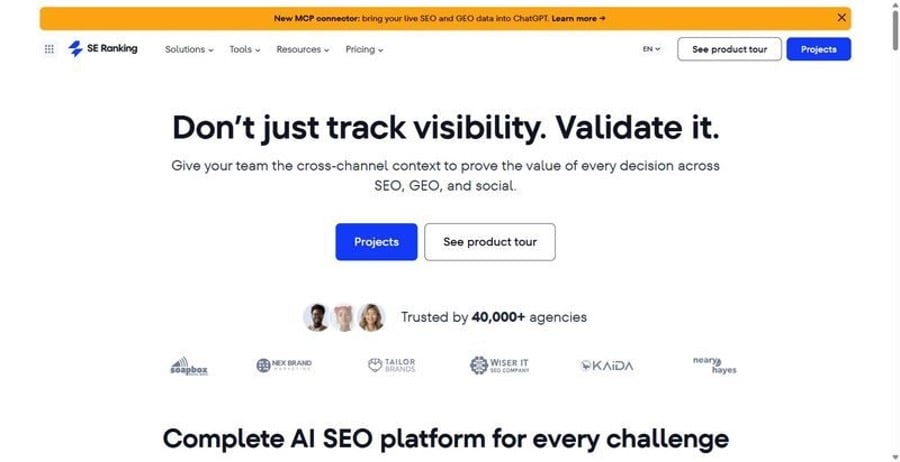
SE Ranking pairs search rank tracking with AI Visibility monitoring in one platform, built for teams that need to read both pictures from the same dashboard.
Best for: agencies and in-house teams that need search plus AI-search visibility in one place.
Standout: Its AI visibility tracking follows your brand across five engines, AI Overviews, AI Mode, ChatGPT, Gemini, and Perplexity, with competitor benchmarking and cached copies of the actual answers. When a citation appears or vanishes, you open the source answer instead of watching a score move with no explanation attached.
Pros:
- Tracks rankings across Google, Bing, and YouTube alongside all five AI engines in one dashboard
- Benchmarks your AI-answer share against competitors and stores cached answers for same-week diagnosis
- Researches keywords across a 5.5B-keyword database spanning 188 country databases
- Audits sites on 115+ checks and includes API plus MCP access on every plan tier
Cons:
- Scaled AI-search tracking sits partly behind the paid AI Search add-on, so cross-engine depth is not fully in the base plan
- Built for systematic multi-client use, not a first tool for occasional users
- Some databases run smaller than the longest-established incumbents
Pricing: from $129/mo (billed annually, $103.20/mo); AI Search add-on from $89/mo ($71.20/mo annual).
What we’re seeing: Across our client accounts, roughly 30% of US keyword SERPs now trigger AI Overviews (SE Ranking, 2025), and visitors from AI platforms spend 68% more time on-site than organic ones, with ChatGPT driving over 77% of AI-referred visits. For teams that want search and AI presence measured together, this is where we start.
2. Google Analytics 4
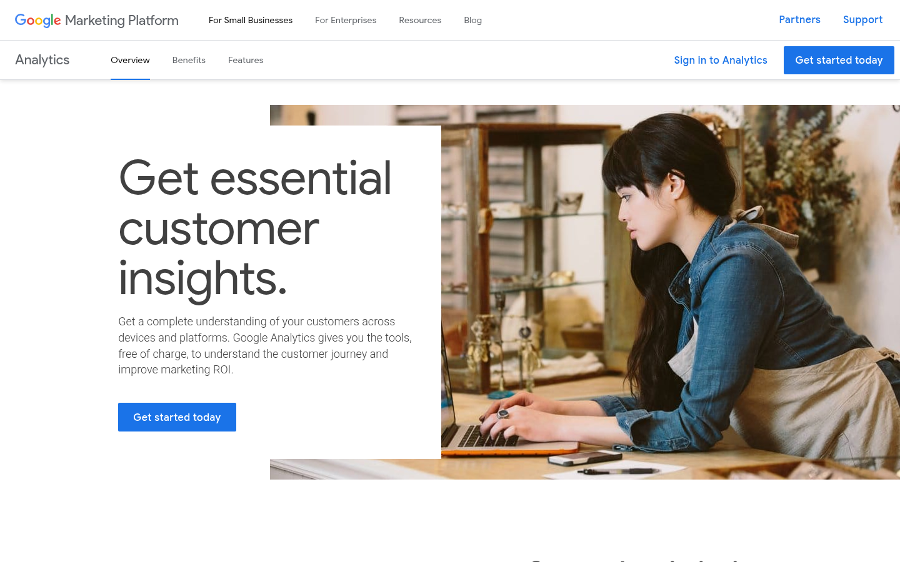
Google Analytics 4 measures on-site behavior across web and app in one property, the free baseline for seeing what a visitor does after they land.
Best for: measuring what AI-referred and organic visitors actually do on-site.
Standout: GA4 is where you find out whether AI-referred traffic behaves differently once it arrives. Cross-platform measurement, machine-learning predictions, and native links to Search Console and BigQuery let you segment sessions by source and compare engagement, conversions, and retention between an AI-referred visitor and an organic one.
Pros:
- Segments traffic by source, medium, and landing page at no cost
- Predicts behavior with built-in machine-learning metrics
- Connects natively to Search Console, Google Ads, and BigQuery
- Measures web and app sessions inside a single property
Cons:
- Attributes AI-referral traffic inconsistently, so many ChatGPT and Perplexity visits fall into direct or referral buckets
- Demands a steep learning curve before the reports read cleanly
Pricing: Free (GA360 enterprise pricing is custom, quoted by sales).
What we’re seeing: Every account we run keeps GA4 as the measurement layer, but we stopped trusting its channel labels for AI traffic in 2025. What we do now: build a manual segment for known AI referrers and read engagement there. It answers what visitors do, not reliably where they came from.
3. Ahrefs
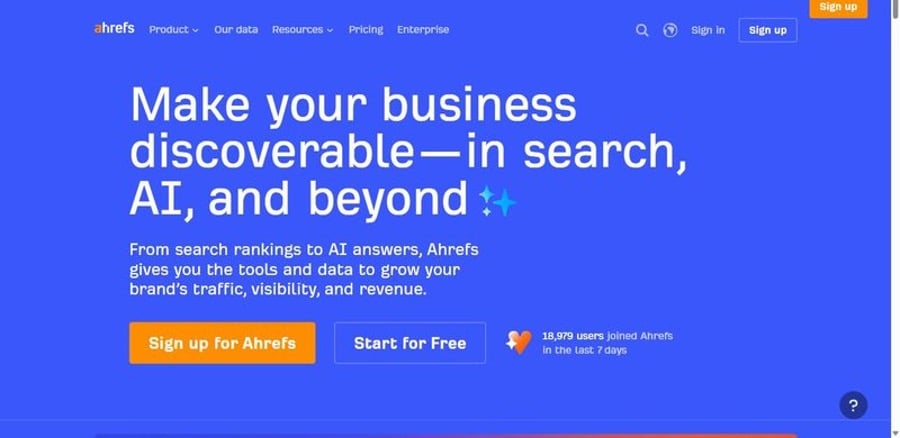
Ahrefs is a backlink and competitive-research platform, useful here because AI answers lean on many of the same authority signals that organic rankings do.
Best for: teams whose AI-answer presence rides on authority and backlinks.
Standout: Its backlink index is one of the largest in the category, and that matters for AI visibility: engines pull disproportionately from pages with established authority. Site Explorer shows which of your pages carry the link equity that makes them citation candidates, and its newer Brand Radar tracks brand mentions surfacing across AI answers.
Pros:
- Maps backlink profiles from one of the category’s largest indexes
- Surfaces the pages carrying the authority AI engines tend to favor
- Tracks brand mentions across AI answers via Brand Radar
- Runs site audits and rank tracking alongside the link data
Cons:
- Ships AI-visibility features that are newer and thinner than its core link tooling
- Climbs in price fast, from a $29/mo Starter tier to agency-scale plans in the hundreds per month
Pricing: from $29/mo (Starter); higher tiers scale to $449/mo (Advanced).
What we’re seeing: When a client’s citations track their strongest pages, Ahrefs explains why faster than anything else we run. We treat it as the authority-diagnosis layer, not the AI-tracking layer. For teams whose AI presence follows their backlink profile, that split of duties earns its place.
4. Sprout Social
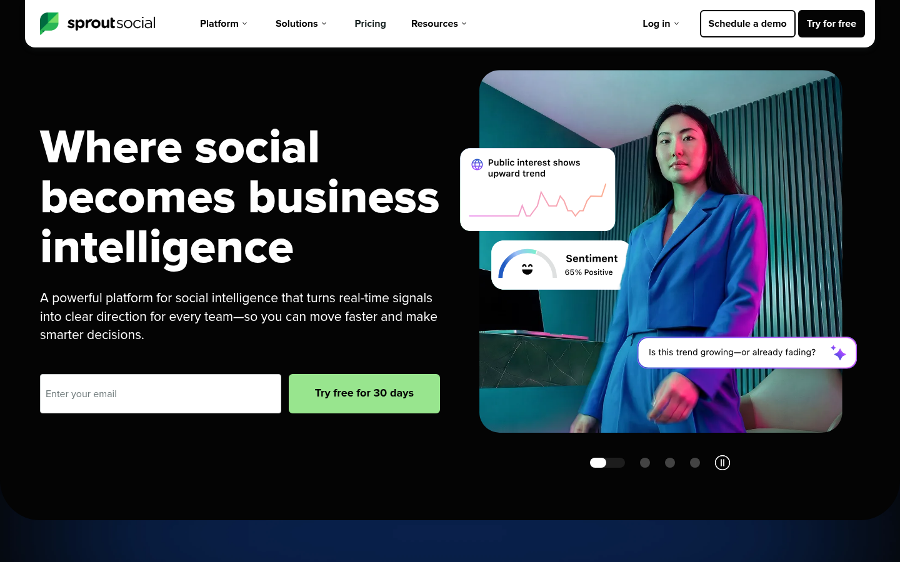
Sprout Social is a social media management suite with premium analytics and listening, relevant here because AI answers sometimes cite social profiles and posts.
Best for: brand and social teams tracking the social presence AI answers sometimes cite.
Standout: Sprout’s listening and competitor reporting show how your brand travels across social platforms, and social profiles surface in a measurable share of AI answers across our tracking set. Its unified inbox, sentiment analysis, and cross-network analytics give social teams the evidence to see which posts and profiles are gaining ground engines occasionally pull from.
Pros:
- Consolidates publishing, engagement, and a shared inbox across networks
- Reports competitor performance and audience sentiment
- Runs social listening across keywords and locations
- Builds team approval workflows for multi-client management
Cons:
- Charges per seat, so costs climb quickly across a larger social team
- Covers social only, leaving the rest of the AI-visibility picture to other tools
Pricing: from $99/seat/mo (Essentials); $79/seat/mo billed annually.
What we’re seeing: Social citations in AI answers are real but inconsistent across our accounts, so we treat Sprout as coverage for one channel, not a visibility strategy. For brand and social teams already living inside it, the listening data doubles as an early signal of where social presence is building.
5. Mailchimp
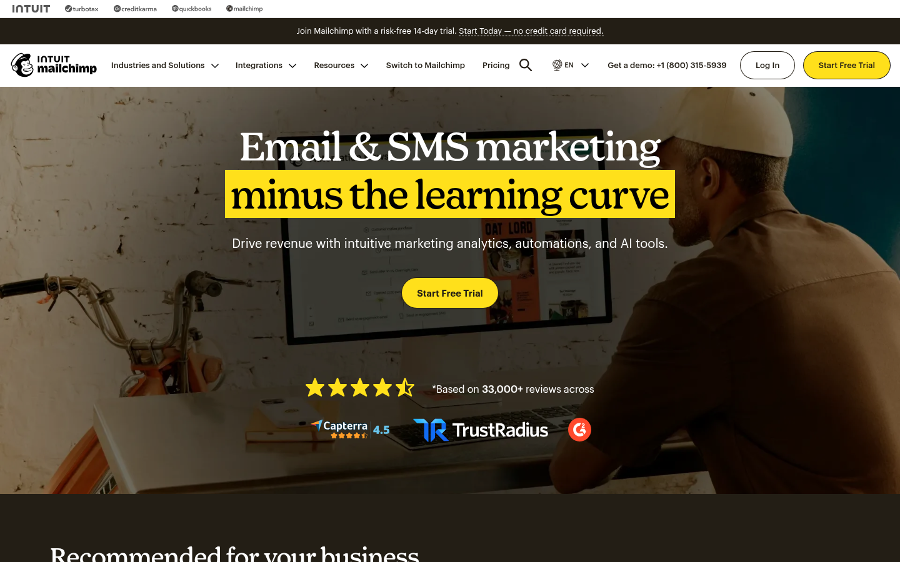
Mailchimp is an email marketing platform for reaching an audience you own, the one channel AI answers cannot route around.
Best for: owned-audience email, the channel AI answers cannot disintermediate.
Standout: Its campaign builder pairs designed templates with segmentation and customer journeys, so a list you built stays reachable when an AI summary swallows the click to your site. Standard tier adds automation flows and behavior prediction; built-in AI drafts copy and layouts in place.
Pros:
- Reach subscribers directly, bypassing the AI answer layer
- Segment by behavior and automate journeys on Standard and above
- Draft copy and layouts with built-in AI assistance
Cons:
- Cost climbs with contact count, not with value sent
- Not built for the advanced lifecycle work ecommerce tools handle
Pricing: Free tier (up to 250 contacts); Essentials from $13/mo (500 contacts, 5,000 emails/mo); Standard from $20/mo.
What we’re seeing: Across accounts, email is the visibility that does not move when the answer layer does. When a client’s AI citations dip one week, the subscriber list is still there on Monday. Mailchimp is not an AI-search tool, but it protects the audience AI cannot reroute.
6. Semrush
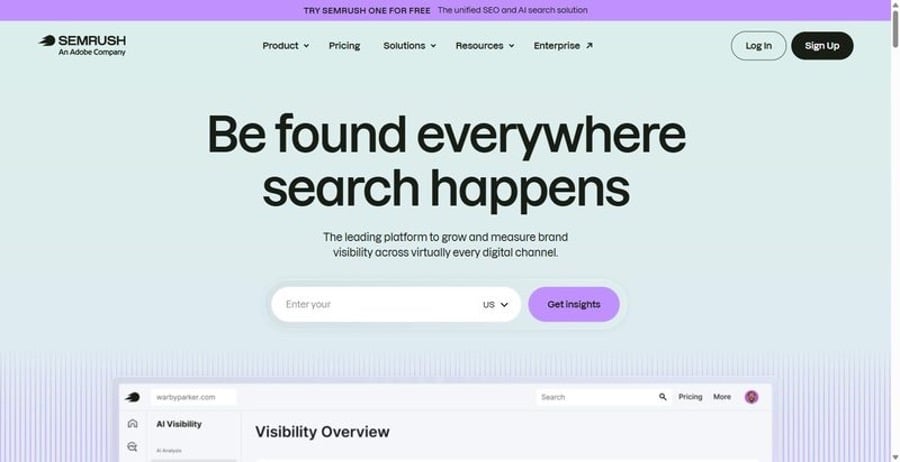
Semrush is a broad SEO suite that folds keyword research, rank tracking, and site audits together with prompt tracking across major AI engines.
Best for: teams wanting one all-in-one SEO plus prompt-tracking suite.
Standout: Its AI visibility tracking lives inside a wider SEO platform, so one login covers organic positions and prompt monitoring across Google, ChatGPT, Perplexity, and Gemini. For a team already running its SEO here that wants AI-search added without a second vendor, that consolidation is the draw.
Pros:
- Track keyword positions and run site audits in one place
- Monitor prompt visibility across ChatGPT, Perplexity, and Gemini
- Run competitor and keyword-gap analysis beside AI-search data
Cons:
- Entry price sits above leaner setups doing similar tracking
- Breadth brings complexity; most teams use a fraction of it
Pricing: From $139/mo (SEO plan; $117.33/mo billed annually); 7-day trial.
What we’re seeing: Semrush is a capable option here, not our first call. For teams already standardized on it, switch the prompt tracking on before buying anything separate. For teams starting fresh on AI-search visibility, we found more focused coverage elsewhere, without the full-suite price.
7. Canva
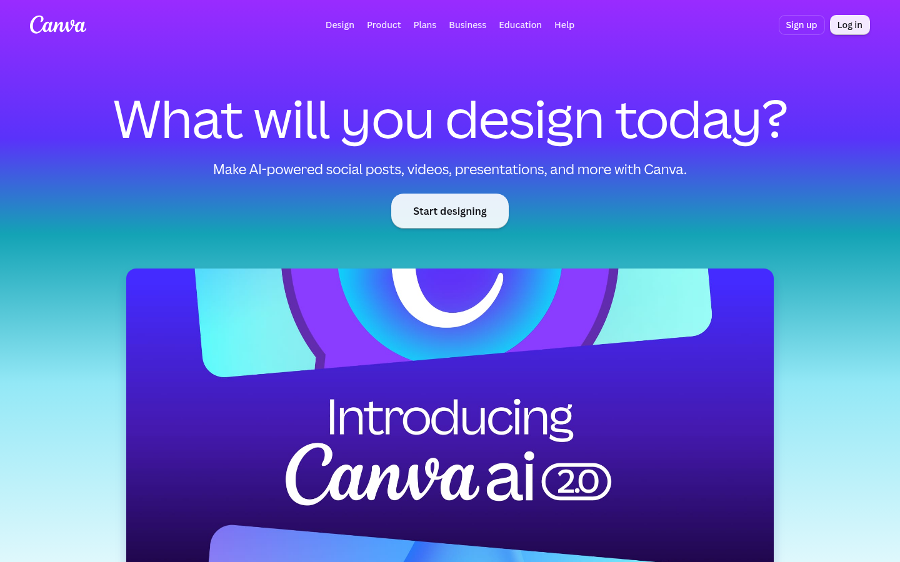
Canva is a design tool for producing on-brand social, blog, and campaign visuals quickly, without waiting on a designer.
Best for: producing fast, on-brand creative for the content that earns citations.
Standout: Its drag-and-drop editor, template library, and Brand Kit let a marketing team ship the images, diagrams, and social cards that sit on the pages AI engines cite. Original visuals with real data travel further than stock. AI design tools clear routine work without a design queue.
Pros:
- Produce on-brand visuals fast without a design bottleneck
- Hold colors, fonts, and logos steady with Brand Kit
- Edit with background remover and AI design tools
Cons:
- Not a strategy tool; it makes the asset, not the decision
- Template ubiquity can flatten a brand look across competitors
Pricing: Free tier; Pro about $15/mo (billed annually at $180/yr); Teams from $250/yr per person.
What we’re seeing: Citations follow content worth citing, and credible-looking content gets shared and linked more. Canva is where that creative gets made quickly. It will not tell you what to publish or whether it landed in an answer. Pair it with a tool that measures presence.
8. Surfer
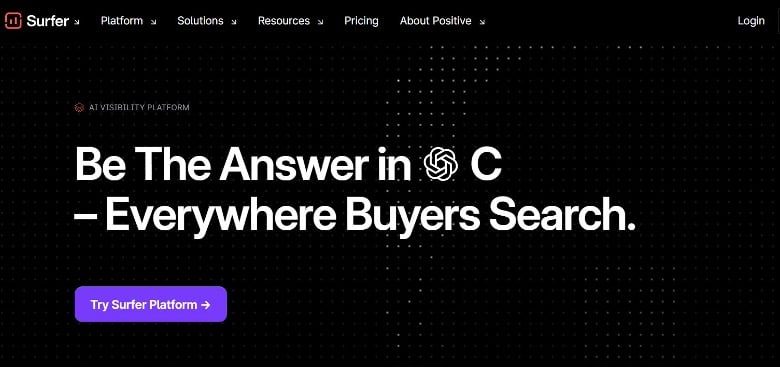
Surfer is a content optimization tool that scores drafts against SERP data so writers structure pages for clean extraction.
Best for: content teams optimizing pages for clean AI extraction.
Standout: Its Content Editor grades a draft against the terms and structure ranking pages already use, which AI engines also lift cleanly. Clear headings, answered questions, and specific terms give an engine something quotable. It now folds in AI-search visibility tracking too.
Pros:
- Score drafts against SERP-based term and structure data
- Structure pages so AI engines extract answers cleanly
- Audit existing content and find gaps to close
- Track AI-search visibility across the major engines
Cons:
- Single-purpose; it optimizes pages and little else
- Guidance can push over-optimization if followed literally
- AI-search tracking costs extra above the base plan
Pricing: From $49/mo (Discovery, billed yearly); Standard $99/mo; AI Search Analytics add-on $158/mo.
What we’re seeing: Clean extraction is half of getting cited, and Surfer is disciplined about the on-page half. What we watch for: writers optimizing to the score instead of the reader, which reads as stuffed to both. Use it to guide structure, not to dictate every sentence.
The Verdict: What We’d Run, and What to Skip
For most agency and in-house teams, SE Ranking is where we would start. It is the one tool here that both earns AI-answer visibility and measures it, pairing rank tracking, an AI Result Tracker across five engines, and competitive research on one screen. Google Analytics 4 sits beside it for what visitors do next.
The reason is measurement, not marketing. Across our tracking, checked weekly, Google AI Mode results overlapped the organic top 10 by only 14% at URL level, and more than 60% of cited domains changed between runs (SE Ranking, 2025). You cannot assume presence from rankings. You have to watch it, per engine, on a fixed cadence.
Skip if you are leading with them as your core digital marketing tools: Canva and Mailchimp. Both earn a place in the stack as supporting players. Canva makes the creative that gets cited; Mailchimp owns the audience AI answers cannot disintermediate. Neither tells you whether an engine is citing you, so neither belongs at the center of an AI-visibility program.
Set your prompt set, check it weekly, change one variable at a time. Where it lands, for now: SE Ranking is the backbone, and everything else supports it.
Frequently asked questions
Which digital marketing tools help you stay visible in AI search?
The digital marketing tools that move the needle pair content quality with measurement. SE Ranking’s AI Result Tracker checks presence across ChatGPT, Gemini, Perplexity, AI Overviews, and AI Mode, while Ahrefs and Surfer support the authority and on-page work behind citations. The point is measuring presence per engine, not assuming rankings carry over.
Can you track your brand’s presence in ChatGPT and AI Overviews?
Yes. Tools like SE Ranking’s AI Result Tracker log how often your brand appears in ChatGPT, Gemini, Perplexity, AI Overviews, and AI Mode for a fixed prompt set. We check ours weekly across accounts. Presence shifts between runs, so track it per engine rather than reading one snapshot.
Do you still need SEO and marketing tools if AI answers are replacing clicks?
Yes, more than before. When an AI answer sits above the results, clicks fall, but the brands cited in that answer still win the demand. Your digital marketing tools now do double duty: earn the ranking that feeds AI answers, and measure whether you actually appear in them across engines.
What are the top digital marketing platforms for 2026?
For AI-search visibility, our shortlist runs SE Ranking, Google Analytics 4, Ahrefs, Sprout Social, Mailchimp, Semrush, Canva, and Surfer. No single platform covers every channel, so treat these digital marketing tools as a stack, not a single purchase. The one we start with is SE Ranking, because it measures presence across AI engines while the rest strengthen the channels those answers pull from.