
How Frameless Pivot Shower Doors Work and What to Know
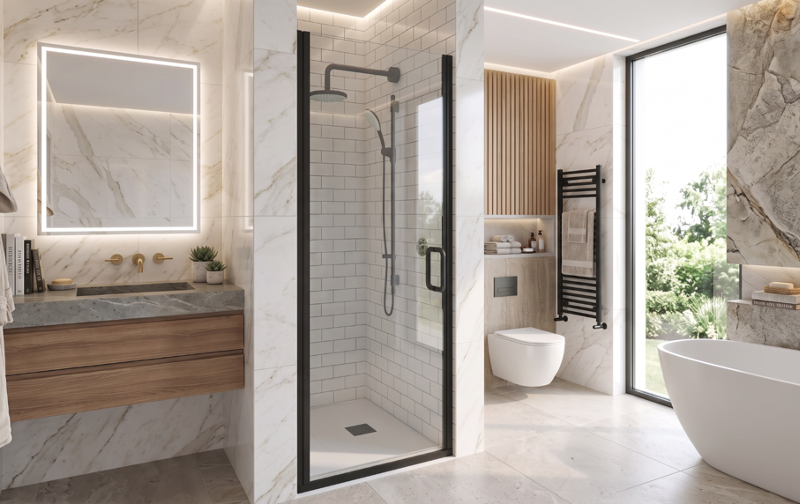
Choosing a shower door is less about picking the most attractive style and more about matching the door mechanism to the bathroom’s layout. A frameless pivot shower door can create a clean, open appearance while offering a practical way to enter and exit a shower enclosure. But the frameless look does not automatically make it the best choice for every bathroom.
The important questions are how the door swings, how much clearance it needs, how the glass and hardware are supported, how effectively water is contained, and whether the existing shower opening is suitable for the installation. Understanding those details before choosing a door can prevent expensive measurement and installation problems later.
What Is a Pivot Shower Door?
A pivot shower door rotates around a fixed pivot point rather than traveling along a bottom track like a sliding door. Depending on the hardware configuration, the pivot axis can be positioned centrally or closer to one side of the door.
Some pivot systems are designed to permit movement in both directions, while others have a defined opening direction. That distinction matters because the door’s movement determines how much clearance is required inside and outside the shower.
The term “pivot” is also sometimes used loosely in the shower-door industry. A product may be marketed as a pivot door even though its hardware resembles a conventional hinge. For that reason, homeowners should evaluate the actual hardware and movement rather than relying only on the product name.
How Does a Frameless Pivot Door Work?
A frameless shower enclosure eliminates the large metal perimeter frame found on traditional framed shower doors. Instead, the glass is supported by purpose-designed hinges, pivot hardware, brackets, clamps, and other components.
The pivot mechanism carries the door through a defined rotational path. The exact construction varies by system, but the fundamental idea remains the same: the door rotates around a pivot axis rather than sliding horizontally.
This arrangement can produce a relatively unobstructed glass surface. With fewer visible metal components around the perimeter, tilework and other bathroom finishes remain more visually prominent.
However, “frameless” does not mean “unsupported.” The glass still requires properly engineered hardware and suitable attachment points. A frameless enclosure depends heavily on accurate measurements, appropriate glass specifications, sound wall construction, and correct installation.
Frameless vs. Framed Shower Doors
The biggest visual difference is obvious: framed shower doors use metal framing around some or all of the glass, while frameless designs minimize that framing. But the difference is not purely cosmetic. Framed systems generally rely on their metal structure for additional support and alignment. Frameless systems place greater importance on the glass, hinges, brackets, and the structure behind the installation surface.
That can make frameless doors particularly attractive in contemporary bathrooms, but it also means that installation tolerances and wall conditions cannot be ignored. A frameless enclosure is therefore not simply a framed enclosure with the metal removed. It is a different approach to supporting and installing the glass.
Benefits of a Pivot Shower Door
A Clean, Open Appearance
One of the strongest reasons homeowners consider pivot doors is visual simplicity. Large areas of uninterrupted glass can make a shower feel less enclosed, particularly when paired with clear glass and minimal hardware. This can be useful in smaller bathrooms where heavy framing or large visual divisions may make the room feel more crowded.
No Sliding Track
Unlike bypass and sliding shower doors, pivot systems do not require a horizontal track for the door to travel along. That eliminates one common area where soap residue, mineral deposits, and bathroom debris can accumulate.
This does not make a pivot enclosure maintenance-free. Hinges, seals, glass edges, and hardware still require routine cleaning. It simply changes the areas that need attention.
Flexible Opening Configurations
Depending on the hardware, pivot doors can be configured for different swing patterns. Some systems permit inward and outward movement, while others are designed primarily for one direction.
This flexibility can be useful when planning around a vanity, toilet, wall, or other nearby fixture. The critical point is to verify the actual swing path before installation rather than assuming that every pivot door operates the same way.
Strong Visual Connection to the Bathroom
Clear frameless glass allows tile patterns, stone surfaces, fixtures, and shower niches to remain visible. This is one reason minimal glass enclosures are commonly associated with contemporary and spa-inspired bathroom designs. The benefit is primarily aesthetic, but it can also affect how spacious the room appears.
Potential Drawbacks to Consider
A pivot mechanism is not automatically superior to every other shower-door configuration. The first concern is swing clearance. Unlike a sliding door, a pivot door occupies space as it opens. The swing path should be checked against toilets, vanities, walls, towel bars, cabinets, and other fixtures.
Water management is another consideration. A frameless enclosure naturally has more open joints than a heavily framed enclosure. Proper sweeps, seals, thresholds, panel positioning, and installation alignment all influence how effectively water stays inside the shower. There is also greater dependence on accurate installation. A door that is incorrectly aligned can rub, fail to close properly, place unnecessary stress on hardware, or create unwanted gaps. For these reasons, the door mechanism should be selected according to the physical bathroom rather than appearance alone.
Pivot vs. Hinged Shower Door
Pivot and hinged shower doors are often confused because both can create a swinging glass door. A conventional hinged shower door rotates around hinges mounted along a vertical edge. A pivot door rotates around a pivot axis positioned according to its hardware configuration. The resulting movement, clearance requirements, and hardware loading can therefore differ.
A hinged door can be a strong choice when the opening and surrounding space naturally accommodate a side-mounted swing. Pivot hardware may be useful when the design calls for a different rotation point or swing arrangement.
There is no universal winner. The better option depends on the opening dimensions, surrounding fixtures, glass size, wall structure, and desired operation.
Pivot vs. Sliding Shower Door
The distinction is much easier to see here. A sliding shower door moves horizontally along a track and therefore does not require the same swinging clearance in front of the enclosure. That makes sliding doors useful in bathrooms where a swinging door would collide with nearby fixtures. The tradeoff is that tracks add hardware and surfaces that require cleaning.
Pivot doors provide a different experience. The opening can feel more direct, and the absence of a sliding bottom track can simplify the visual design. But the swing area must be available. In other words, sliding doors generally trade swing clearance for track hardware, while pivot doors trade track hardware for swing clearance.
Choosing the Right Glass
Safety should take priority over decorative preferences when selecting shower-door glass. Shower enclosures commonly use safety glazing, with tempered glass being a widely used option. Tempered glass is processed so that if it breaks, it generally fractures into smaller, less sharp pieces rather than large, dangerous shards. The U.S. Consumer Product Safety Commission describes tempered glass as being designed to fail in this manner.
ANSI Z97.1 establishes performance and testing requirements for safety glazing materials used in buildings. The current 2026 edition is the latest edition listed by ANSI.
Local building codes can also establish requirements for glazing in shower enclosures. For example, the International Residential Code addresses identification of glazing installed in hazardous locations, including requirements for manufacturer designations.
Glass thickness should not be selected simply because thicker glass sounds stronger. The appropriate thickness depends on the door dimensions, hardware system, engineering requirements, and manufacturer specifications. Common frameless shower-door configurations may use glass around 3/8 inch or 1/2 inch thick, but the correct specification should come from the enclosure design rather than a generic rule.
What to Measure Before Installation
Accurate measurement is one of the most important parts of a successful shower-door project. Do not assume that a tiled shower opening is perfectly square or plumb. Tile, mortar, framing, waterproofing systems, and construction tolerances can create variations that are difficult to see with the naked eye.
Measure the opening at multiple points rather than relying on a single width measurement. The height should also be checked at relevant locations. Walls should be evaluated for plumb, while the curb or shower base should be checked for appropriate slope and level conditions.
The swing path deserves separate attention. Marking the projected path of the door on the bathroom floor can reveal potential conflicts with toilets, vanities, cabinets, or other fixtures before any hardware is installed.
This is one area where guessing is a bad idea. Glass cannot simply be trimmed on site to compensate for a measurement mistake.
Hardware Matters More Than It Looks
A frameless enclosure has relatively little visible structure, which means the hardware becomes both a functional and visual component of the installation. Common hardware finishes include chrome, brushed nickel, matte black, and brass-family finishes. The finish affects appearance, but the more important considerations are compatibility, load capacity, corrosion resistance, adjustment capability, and suitability for wet environments.
The hardware must also be compatible with the specified glass and installation method. A hinge or pivot designed for one glass thickness or mounting configuration should not automatically be assumed suitable for another.
How to Reduce Water Leakage
No frameless shower enclosure should be evaluated as though the glass itself creates a waterproof barrier. Water control depends on the entire enclosure design. Door sweeps, seals, thresholds, wall alignment, panel positioning, and showerhead placement can all affect performance.
The showerhead should ideally be positioned so that its spray does not directly hit the door opening. Where necessary, properly designed seals and thresholds can help control water movement. It is also important to understand the difference between a shower enclosure that controls normal splash and a completely watertight box. Frameless systems intentionally have some open joints, so realistic expectations matter.
Is a Frameless Pivot Shower Door Right for Your Bathroom?
A frameless pivot configuration can make sense when you want a minimalist appearance, have sufficient clearance for the door’s movement, and have a shower opening that can accommodate the required hardware and glass.
It may be less suitable when the bathroom has very limited swing space. In those cases, a sliding enclosure or another space-conscious configuration may be more practical.
The same principle applies to accessibility. A wide, unobstructed entry can be valuable, but the exact opening width, threshold configuration, door swing, and bathroom layout should be evaluated together. Accessibility requirements can also vary by project and jurisdiction.
The right decision is therefore not “frameless versus framed” or “pivot versus hinged.” It is whether the entire door system works with the physical constraints of the bathroom.
Maintenance and Long-Term Care
Routine maintenance is relatively straightforward. After showering, removing standing water from the glass can reduce mineral buildup. Regular cleaning with a product appropriate for the glass and hardware helps prevent soap residue and deposits from accumulating.
Avoid abrasive tools or aggressive chemicals unless they are specifically approved for the glass and hardware finish. Hardware should be inspected periodically for loose fasteners, unusual movement, or signs of wear.
If a door begins rubbing, sagging, or failing to close correctly, do not keep forcing it. Continued use can make an alignment or hardware problem worse.
The Bottom Line
The appeal of a frameless pivot enclosure comes from a combination of clean aesthetics and practical operation. But the mechanism alone does not determine whether the installation will perform well.
Before choosing a door, evaluate the shower opening, swing clearance, glass specification, hardware compatibility, wall conditions, water-management strategy, and applicable building requirements. Those details matter far more than whether a particular style is currently popular.
For homeowners comparing shower-door options, the most useful question is not “Which door looks best?” It is “Which door mechanism fits this bathroom without creating clearance, safety, installation, or water-management problems?” That is the decision that leads to a better result.