
NSFW AI Video Clip Length, Motion, and 8 Second Problem
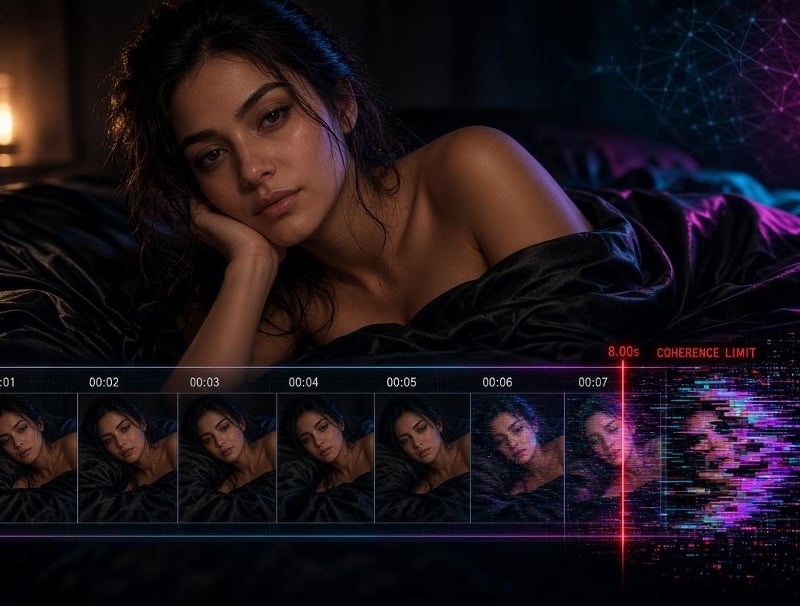
Most AI porn video generators in 2026 still dies in the same place: a few seconds after the first clean frame. Faces hold. Then hips drift. Hands melt. Skin texture crawls. The clip that looked finished at second four looks broken at second nine.
This guide shows what clip length you can actually trust, why motion fails first, and how the 8-second problem still shapes every usable adult clip. You will leave with length rules, motion settings, and a stitch workflow that beats one long generate.
That is the gap between marketing length and watchable length.
What the 8-second problem actually is
The 8-second problem is not one bug. It is the point where three failures stack: identity drift, motion jitter, and texture flicker.
For a year, people treated eight seconds as a hard industry cap. That was never quite true. Eight seconds is the native ceiling on Google’s Veo 3.1 at 1080p and 4K. Other models go longer in one pass. The myth stuck because Veo set the public standard, and because adult clips often fall apart near that same mark even when the slider goes to 15 or 30.
Marketing length vs coherent length
A tool can output 15 seconds and still only hold 6. Coherent length is the last second where the same person, lighting, and body logic survive. After that you get:
- A face that slowly becomes a cousin of the first frame
- Fingers that fuse, split, or lose joints
- Fabric that shimmers instead of folding
- Motion that jumps mid-stroke instead of continuing
Adult image-to-video guides in 2026 still give the same practical ladder: four seconds holds almost always, eight seconds holds usually, twelve seconds holds sometimes. Past that, drift and hand artifacts rise fast.
Why adult video hits the wall sooner
Mainstream video models are trained and moderated for ads, film language, and talking heads. Adult motion is worse for them. Bodies occlude each other. Skin fills most of the frame. Hands stay on-screen. Small errors on a product shot are easy to ignore. The same error on a torso is the whole clip.
Frontier models such as Veo, Runway, and official Kling also refuse or scrub NSFW prompts. Adult generators often run smaller or older motion stacks. That is why NSFW video in 2026 can look a generation behind the best SFW demos even when the stills look current.
How long AI porn videos can be in 2026
As of August 2026, native single generations on major models run about 8–30 seconds. ByteDance’s Seedance 2.5 holds the 30-second single-pass record in several catalogs. Kling 3.0 sits near 15 seconds. Veo 3.1 stays at 4, 6, or 8 seconds, with 1080p and 4K locked to 8. Extensions can assemble longer files, but quality and resolution usually drop.
Native cap vs extended cap
| Model (2026) | Native single pass | Extended / chained | Catch |
| Veo 3.1 | 4 / 6 / 8 seconds | Up to 148s at 720p | High-res stays at 8s |
| Kling 3.0 | Up to 15 seconds | About 3 minutes paid | Reviewers report drift past ~2 minutes |
| Seedance 2.5 | 4–30 seconds | Limited official extends | Longest clean single pass |
| Runway Gen-4.5 | About 5–10 seconds | Editor-led assembly | Strong control, short native take |
| Typical NSFW host | 5–15 seconds advertised | Stitch / loop tools | Coherent ceiling often shorter |
Those numbers describe general video models. Dedicated adult hosts advertise 10, 15, even 60 seconds. Treat the published max as a file length, not a quality promise. One 2026 adult-tool comparison still scored coherent NSFW length far below the marketing number on several names.
What “a minute of AI porn” really means
A one-minute file in 2026 is almost never one generation. It is:
- Several 4–8 second shots
- Last-frame to first-frame handoff
- An editor cut, fade, or speed ramp
- Optional upscale and deflicker
OpenAI’s Sora 2 API, which could chain toward 120 seconds, shut down on September 24, 2026. That closed one of the longer official extension paths. The remaining long routes are Veo-style 720p extends, Kling paid extends, and manual assembly.
Why motion fails before resolution does
Temporal consistency is the hard problem. An image model finishes one frame. A video model must keep objects, skin, and motion legal across dozens of frames. LTX’s 2026 production notes still call that the hardest job in the category: flicker, warble, identity drift, and motion jumps each have different causes.
The four artifacts that kill a clip
Watch for these in order. They usually arrive before the resolution looks “low.”
- Flicker / shimmer: pores, sheets, and tattoos crawl between frames
- Identity drift: eyes, jaw, or breast shape migrate
- Motion discontinuity: the body jumps instead of following a path
- Anatomy collapse: hands, mouths, and genitals lose structure under load
Hands are the classic fail. Training data underrepresents them, and temporal layers are weakest where the model is least sure. Fast gestures make it worse. A still with hidden or resting hands survives video better than a still with complex finger poses.
Why the middle of the clip is the danger zone
Many models look fine at the first and last frame and break in the middle. That is trajectory loss. The model starts a motion, then loses the vector and invents a new one. Keyframe or first/last-frame tools exist because they pin both ends and force the middle to interpolate instead of wander.
Research on sequential-action video in 2026 still finds the same trade-off: as motion accumulates and the action changes, appearance drifts. End-to-end generators try to solve look and movement at once, then lose the face.
The speed versus smoothness tradeoff
Clip length is not independent of motion speed. Fast adult action compresses more error into each second. Slow motion gives the model fewer hard guesses.
A 2026 NSFW motion guide puts the tradeoff in plain numbers: slow or gentle motion can hold around six seconds; moderate motion is safer near four; fast or energetic action often needs two to three seconds, then a stitch.
One action per clip
The prompt that fails most often stacks verbs: turn, lean, grab, and change expression in one breath. That is three scenes. Split them.
Use one dominant motion:
- A slow push-in
- A hip roll that stays on a single axis
- A head turn with a fixed camera
- A fabric slide with almost no camera move
If the platform has a motion strength slider, start low. High strength raises flicker, identity drift, and anatomical corruption. Low strength looks less “porn-fast” and more watchable. That is the right trade for keepers.
Camera and body should not fight
A moving camera plus a moving body doubles the search space. Pick one.
- Body moves, camera locked
- Camera moves, body mostly still
- Tiny parallax only
“Handheld, orbit, zoom, and thrusting” in one prompt is how you get jitter. Adult clips also punish tiny repeating patterns: lace, mesh, blinds, and busy sheets. Simplify the set if shimmer shows up.
Image-to-video beats text-to-video for adult clips
Image-to-video (I2V) is the 2026 default for anyone who cares about the same person across frames. You lock the face and body in a still, then ask for limited motion. Text-to-video still surprises on cinema language. It is worse at keeping one specific adult body stable.
Many working pipelines start with a generated still, not a live photo of a real person. That avoids the consent mess that undress-from-photo tools created. If you need the still-first path, compare current undress AI apps only for tools that also animate a generated image you already own—not as a way to strip someone who did not agree.
Why the still has to be video-ready
A weak still becomes a worse clip. Motion magnifies bad framing.
Before you animate:
- Face large enough to stay readable after crop
- Hands out of frame or in a simple rest pose
- One light direction
- No tiny high-contrast patterns
- Room to move without hitting the frame edge
Then write motion as verbs and camera, not as style words. “Photoreal, cinematic, 8k” does not tell the model what moves. “Slow inhale, shoulders settle, camera locked” does.
Reference frames beat longer prompts
A 2,000-word prompt will not outrun a last-frame lock. If the tool accepts first and last frames, use them. The last frame can be a second still of the same person a few inches further along the action. The model then fills the path instead of inventing a new body at second six.
Seedance 2.5’s long native window is useful here because it also takes multiple reference images. Length without identity lock is just more seconds of drift.
How to build past eight seconds without wrecking the scene
You do not wait for a 90-second perfect generate. You shoot coverage.
The stitch method that actually holds
- Generate a 4–6 second master with low motion.
- Export the last clean frame.
- Use that frame as the next first frame.
- Change only one thing: angle, distance, or action phase.
- Cut on a blink, a body peak, or a camera settle.
- Deflicker only after the cut is chosen.
Overlap of about one second helps when a tool’s “extend” feature re-uses tail context. Veo-style extends add roughly seven new seconds per pass with a one-second overlap, but they also drop to 720p on long chains. Do not extend a clip that already shows melt. You will extend the melt.
Loops versus scenes
A five-second loop is easier than a story. If the product is a feed clip, design a closed motion: the last pose almost matches the first. If the product is a scene, accept cuts. Viewers already accept cuts in real adult video. They do not accept a nose that migrates.
Multi-shot models such as Kling 3.0 can label several shots in one generate. That helps SFW narrative. For adult work, separate generates still give you more control when one shot fails and the others are keepers.
How to choose clip length for the scene you want
Match length to motion load, not to the slider’s maximum.
A simple length rule
- 2–4 seconds: fast action, hands in frame, new character
- 4–6 seconds: one slow body move, locked camera
- 6–8 seconds: gentle motion, strong still, best model you can access
- 8–15 seconds: only after the short version already holds
- 15+ seconds: assemble, do not pray
That rule matches what adult tutorials kept repeating through 2026 and what general model tables show about native caps. Longer is available. Stable is rarer.
Credits, queues, and why short wins twice
Length is also money and time. Generation time scales close to linearly with seconds. An 8-second 720p Kling-class clip can finish in about a minute and a half end to end; a 15-second version jumps toward two minutes of generate time alone. Higher resolution multiplies that again. Failed long clips waste the expensive run. Failed short clips are cheap retries.
Run three short takes before one long take. Keep the take where skin and hands survive, even if the motion is quieter than you wanted. You can cut quiet clips into a harder edit. You cannot edit a melted hand back into a hand.
What still will not be solved by a better prompt
Prompt skill helps. It does not repeal physics in the latent space.
A 2026 prompt corpus of 8,131 consistency-lock statements found creators mostly lock face identity, appearance, outfit, and background. Expression almost never gets locked. That matches what you see in adult video: the face stays “sort of her” while the mouth and eyes go slack or morph. Write the locks. Also shorten the shot.
Google Research published work in September 2026 on coherent long-form pipelines that treat minutes-long video as world-state tracking, not one giant sample. That is the research direction. It is not what consumer NSFW buttons do today. Until those orchestration layers show up in adult tools, your editor is the world-state tracker.
Do not confuse detection news with generation quality either. Deepfake detectors got worse on 2025–2026 video models because whole-frame generation left fewer paste seams. That says fakes are harder to catch. It does not say a 20-second AI sex scene holds anatomy. Those are different tests.
FAQ
How long can an AI porn video be in 2026?
Usable clips are usually 4–8 seconds. Some models generate 15–30 seconds in one pass, and a few adult hosts advertise a minute. Coherence on bodies, hands, and skin still drops after about eight seconds for most setups, so longer files are normally stitched.
Why do so many AI videos stop at 8 seconds?
Eight seconds is Veo 3.1’s native high-res cap, and it became the number everyone repeated. It is also near the point where identity and motion errors become obvious in adult footage. Other models go longer. Watchable adult motion often does not.
Can I make a full one-minute AI porn video?
Yes, as an edit. Generate several short shots, lock the last frame of each into the next, and cut. Chained extensions exist, but they often lower resolution or add drift. Shot-by-shot assembly is the reliable minute.
Why does the motion look jittery or melted?
The model is re-guessing the body every frame. Fast action, busy textures, moving cameras, and long duration all increase that guesswork. Slow the move, shorten the clip, lock a still, and keep hands simple.
Is image-to-video better than text-to-video for NSFW?
For a specific person, yes. A strong still anchors identity. Text-to-video can invent a new face by second six. Start with a generated still you already like, then add one motion.
Which setting matters more, length or motion strength?
Both, but motion strength ruins short clips too. Low strength plus 4–6 seconds beats high strength plus 12 seconds. Speed is the hidden length limit.
Do mainstream video models make adult clips now?
Most top SFW models still refuse or scrub explicit prompts. Adult platforms use different stacks or looser filters. Expect shorter coherent windows and more retries than the Veo or Kling demo reel.
Conclusion
Three facts decide AI porn video in 2026. First, native generators can now spit out 8–30 seconds, but adult coherence still clusters around 4–8. Second, motion quality fails before megapixels do: drift, flicker, and hands set the real cap. Third, the 8-second problem is a workflow problem. Treat eight seconds as a shot, not a movie.