
Pirated Fonts: 7 Red Flags to Check Before Downloading
Every designer has been there: staring at a project and thinking, “This typeface is perfect, now just where can I get it for free?”. Then you start searching and come across all these sites promising “free fonts” or “font freebies,” but honestly, they’re more often than not a minefield. What you find when you type in “font pirate sites” or wonder “where to pirate fonts” is rarely what you hoped for.
This article walks through seven concrete warning signs to check before downloading a font from an unfamiliar source — and what to do instead.
Why Font Piracy Is More Complicated Than It Looks
Before jumping into red flags, it helps to understand what’s actually at stake.
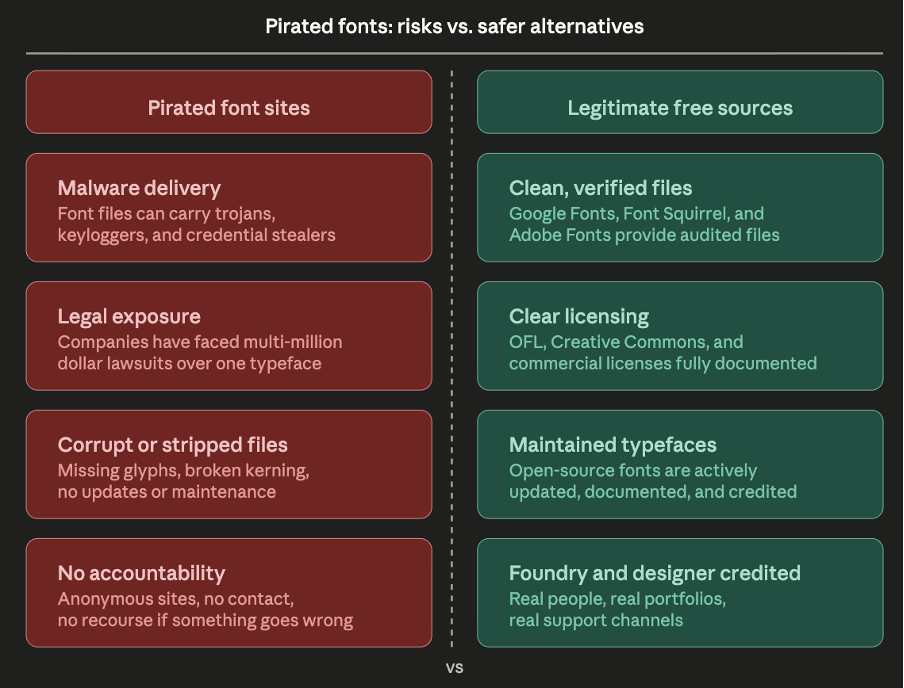
Type files are software. Mostly, what you find are places that carry a big risk. In most places, fonts are covered under software copyright law, which means if you just go ahead and use them without permission, you could get into real trouble. Type foundries have been known to chase down companies that use their fonts without paying the price, and it can get expensive. According to Extensis, NBCUniversal was sued for $3.5 million over the use of just one typeface. Haribo was sued for printing a typeface on product packaging when they only held a desktop license. These cases involved brands with full legal teams. For a freelancer or small studio, the exposure would be proportionally more damaging.
The cybersecurity angle is equally serious. Security researchers have flagged something that most designers never think about: font files can carry malicious code that runs the moment you install them. Fonts feel harmless — they’re just letters, right? That’s exactly what makes them a convenient wrapper for trojans, keyloggers, and software designed to lift your credentials quietly in the background. Sites distributing illegal fonts have little reason to care about the integrity of their files — and plenty of reasons to monetize through bundled malware or aggressive ad networks.
Before You Download from Any Unknown Site
One step many designers skip: checking whether the website itself is trustworthy before engaging with it at all. Tools like TrustRacer, a digital safety platform that helps users make safer online decisions, let you instantly check website trust score for any URL, pulling together data on domain age, threat history, and reputation signals. If a site scores poorly, that’s reason enough to close the tab — regardless of what typefaces it claims to offer.
Now, on to the red flags themselves.
Red Flag #1: Vague or Missing Licensing Information
Any font source worth trusting will be upfront about licensing. Is it personal use only? Commercial? Open-source under SIL OFL? Legitimate platforms spell this out, link to the actual license document, and tell you who designed the typeface and which foundry released it.
The shadier corners of the internet do none of that. You’ll see things like “free for all uses” or “no restrictions”—or just a download button with nothing else. Those claims are almost always meaningless or made up. A font distributed without its proper license isn’t actually free to use in commercial work. It’s unauthorized. And if you drop it into a client project, the legal exposure lands on you.
If you work with Adobe-supplied fonts, their Adobe font use rules explain exactly what you can and cannot do with each typeface available through a Creative Cloud subscription. It’s worth reviewing before assuming any font is cleared for every purpose.
Red Flag #2: No Traceable Origin or Accountability
Reputable sources — Google Fonts, Font Squirrel, DaFont, Fontsarena — don’t hide who they are. You can find contact pages, foundry attribution, and designer credits. With sketchy sites, none of that exists. No About page, no company name, no real people attached to it anywhere.
This matters because accountability is what makes trust possible. When a site distributes typefaces anonymously, there’s no one to contact if a file turns out to be corrupted — or if you discover later that the “free” font you used in a client project was a commercial typeface with an active EULA and an enforcement-minded foundry behind it.
Red Flag #3: Misleading or Aggressive Download Buttons
This is one of the most immediate practical dangers for anyone exploring how to pirate fonts — and it catches experienced users off guard regularly.
Many low-quality font aggregator sites scatter multiple fake “Download” buttons across the page. These buttons don’t download a typeface. They trigger ad redirects, push notification requests, or — in worst cases — initiate downloads of executable files dressed as font installers.
The real download link, if one exists, is usually much smaller and harder to find. A useful habit: hover over any button before clicking and check the URL it points to in the browser’s status bar. If a “Download” button leads to a domain completely unrelated to the site you’re on, treat it as a warning and leave.
Red Flag #4: ZIP Files That Contain Executables
Font files end in .ttf, .otf, .woff, or .woff2. That’s it. There is no legitimate reason for a font download to include a .exe, .bat, .msi, or .js file.
When you download a font archive from an unknown source, open the ZIP and check its contents before installing anything. If you find anything other than type files and perhaps a plain-text license document, delete the archive immediately. This is one of the most direct vectors for malware delivery through typeface downloads.
A related warning: Be cautious about ZIP files that are unusually large for their stated contents. A single font family shouldn’t weigh several hundred megabytes. Anything disproportionate warrants a malware scan before you open it — and serious consideration of whether the download is worth the risk at all.
Red Flag #5: A Brand-New or Recently Changed Domain
Font piracy sites tend to have short lifespans. They get reported, taken down, and reappear under new domains. A domain created within the last few months that claims to host a comprehensive library of professional typefaces should raise immediate questions.
You can check domain registration dates using freely available WHOIS lookup tools. A site with a brand-new domain offering thousands of premium fonts is, at minimum, something to approach with real caution. When you check a site’s trust score using a tool like TrustRacer, domain age is one of the signals factored into the assessment — and a very new domain combined with other risk indicators is a strong reason to disengage before clicking anything.
Red Flag #6: Full Premium Families Offered “Free” With No Explanation
Some commercial typefaces have legitimate free weights or trial versions released by the foundry itself. But when a site offers a complete premium typeface family — all weights, all italics, extended character sets — with no explanation of how it’s free, something is wrong.
You can be sure that when a big, expensive font is on offer for free, something fishy is going on. If it’s a big name like a geometric sans-serif or a top-end display family and you can get it for nothing, one of three things is true. Either it’s not actually the font you wanted and is just a dodgy clone, or the one you’ve got is corrupted or been stripped down, or worst case, some unauthorized person is pushing it out and flouting the law. Monotype’s guidance on font piracy clarifies that unauthorized redistribution of their typefaces violates licensing terms regardless of whether money changed hands during the transaction.
Red Flag #7: No Designer Credit or Community Presence
Every font comes from somewhere. Real typefaces have a paper trail — designers with portfolios, foundries with websites, discussions scattered across typography forums, Behance, Dribbble. If you search a font name and all that comes back is a wall of download pages with no design history, no designer name, no foundry mentioned anywhere — that silence is a signal worth paying attention to.
Legitimate free fonts tend to have communities around them. Open-source typefaces distributed through Google Fonts are maintained, updated, and fully documented — and their designers are credited by name. Their Google Fonts guidance on open-source fonts explains clearly how the library works and what the licensing actually covers. Compare that level of transparency with a page offering “500 premium fonts, free download” and no attribution, and the difference becomes immediately clear.
Where to Find Legal Fonts Instead
If you’ve been wondering where can I pirate fonts or what the actual alternatives are, the honest answer is that the options for legitimate, free typography are broader than most people realize — and they’ve expanded considerably over the past decade.
For free commercial use:
- Google Fonts — 1,500+ families, all free for any use
- Font Squirrel — curated, all commercially licensed
- Fontsarena — free font research, alternatives to premium typefaces, and done-for-you research articles on typography
For affordable premium fonts:
- Adobe Fonts (included with Creative Cloud)
- MyFonts, Fontspring, and direct foundry websites
- Creative Market for independent designers at accessible prices
For testing before you buy: Many foundries offer free trial weights specifically for evaluating a typeface. These are licensed, safe, and won’t expose you to any legal or security risk.
Red Flags vs. Safe Signs
| Warning sign | What it likely means |
| No license information listed | The font is pirated or mislabeled |
| Multiple fake “Download” buttons | Ad-driven site, possible malware delivery |
| ZIP contains .exe or .msi files | High risk — likely malware |
| No designer or foundry credited | Untraceable origin, no accountability |
| Domain registered within a few months | Possibly a short-lived piracy operation |
| Full premium family offered for free | Almost certainly unauthorized redistribution |
| No contact page or company info | Anonymous, no recourse if something goes wrong |
The Bigger Picture
The search terms “where to pirate fonts” and “how to pirate fonts” attract real traffic, which means real designers are making this calculation regularly. The good news is that the legitimate free font ecosystem has grown significantly. The piracy case has genuinely weakened over the past decade.
When the budget is a real constraint, the better path is to communicate that to clients clearly. Most will accept a well-chosen free alternative, or help cover licensing costs when the situation is explained. What’s much harder to walk back is a malware infection, a cease-and-desist from a type foundry, or a client project that can’t launch because a typeface in the brand files was never properly licensed.
Checking a font source carefully before downloading takes two minutes. Those two minutes are consistently worth it.